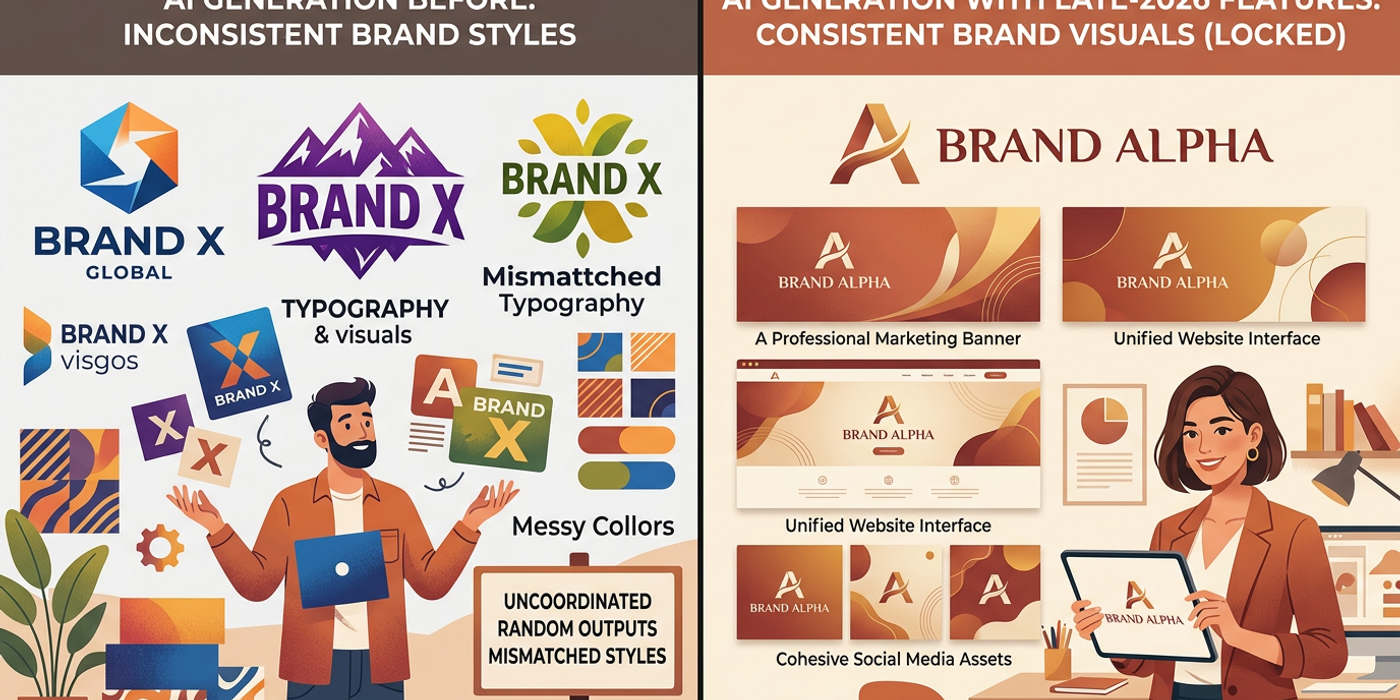
Late-2026 AI models introduced brand style locking. Ideogram 4.5, Nano Banana 2.1, ChatGPT Images 2.5 and Flux 3 Image keep brand visuals consistent at scale.
Brand consistency has been the Achilles' heel of AI image generation since the beginning. You nail the perfect look for your first batch, then struggle to reproduce it for the next campaign. Late 2026 changed that. The latest generation of AI image models ships with features purpose-built to lock in your brand's visual identity — from in-place editing that preserves every pixel outside your target area, to template systems that carry brand guidelines through every generation.
Here is what changed and how Hong Kong brands can use it.
New Model Features That Lock Brand Style
Ideogram 4.5 — In-Place Editing Without Affecting the Rest
Ideogram 4.5 introduced what many creators are calling the most useful brand consistency feature of the year: in-place editing. You generate a product shot in your brand's colour palette, then select a specific area — the product label, the background, a prop — and regenerate only that part. The rest of the image stays untouched, preserving lighting, composition, and every other detail that makes your brand's visuals recognisable.
For Hong Kong e-commerce brands producing catalogue images at scale, this is transformative. A batch of 50 product photos no longer needs regenerating because the client wants a different background colour. You edit in place, approve, and move on.
Nano Banana 2.1 — Consistent Style at Half the Cost
Google's Nano Banana 2.1 reduced pricing by 50% while improving its style-consistency capabilities. The model now maintains brand colour palettes across unrelated generations more reliably than its predecessor. For HK creative agencies juggling multiple brand accounts, this means you can assign each account a consistent look without manually re-prompting style instructions every time.
The cost reduction also changes the economics of brand-consistent production. At 50% less per image, running style-safeguarded generations as your default workflow — rather than an occasional quality-check — becomes financially viable for routine social media content.
ChatGPT Images 2.5 — Templates That Enforce Brand Guidelines
OpenAI's ChatGPT Images 2.5 introduced a template system that functions as a brand style guide in model-readable form. You define your brand's visual parameters — colour hex codes, composition rules, typography preferences — and the model applies them as a constraint layer on every generation within that session.
This is particularly useful for Hong Kong agencies producing content across multiple brands in the same day. The template system eliminates the cognitive load of remembering each client's style preferences. Switch templates, switch brands, no drift.
Flux 3 Image — Multi-Step Editing Preserving Style
Black Forest Labs' Flux 3 Image enables multi-step editing where each edit operation preserves the stylistic context from the previous step. Start with a brand-compliant base image, then iterate — change the product angle, adjust the lighting, swap the background — without the model drifting away from the original brand style.
For product photography workflows that typically go through three to five revision rounds, this multi-step preservation means the first-round brand direction carries through to the final approved image with no manual re-prompting.
Building a Brand-Locking Pipeline for Your Agency
The real power comes from combining these features into a cohesive production pipeline:
Phase 1 — Brand Baseline Set up a reference batch with Nano Banana 2.1 or ChatGPT Images 2.5 templates. Generate 10-20 images in your brand style using the same seed family and style reference. This establishes your visual baseline.
Phase 2 — Production at Scale Generate the bulk of your content using the model whose brand-locking feature best fits the task. Use template-mode for template-defined outputs and standard prompting for creative exploration.
Phase 3 — Fast Revision with In-Place Editing When the client requests changes, route revision requests through Ideogram 4.5's in-place editing. Change what needs changing — nothing else. This phase used to mean full regenerations and manual re-styling. Now it is a single targeted edit.
Phase 4 — Consistency Audit Run a quick side-by-side comparison of the new batch against the brand baseline. If any image drifted, Flux 3 Image's multi-step editing can re-apply the original style context without starting from scratch.
What This Means for Hong Kong Brands
Hong Kong's creative industry moves fast. E-commerce brands cycle through product shots weekly. Real estate agencies refresh listings daily. Restaurant groups update menus monthly. All of them need brand consistency to maintain recognition across channels.
Before late 2026, maintaining that consistency with AI required meticulous prompt engineering, style reference libraries, and manual quality checks. The new model features don't eliminate the need for human oversight, but they dramatically reduce the gap between "first generation" and "brand-compliant output."
For small and mid-sized HK brands that can't afford dedicated creative teams, this is especially significant. The barrier to producing on-brand AI visuals just dropped — not because prompting got easier (though it did), but because the models themselves started enforcing consistency as a first-class feature.
Frequently Asked Questions
Q: Can Ideogram 4.5's in-place editing work on any image or only new generations? A: It works on any image uploaded to the platform. As long as the resolution and format are compatible, you can select an area and edit it in place.
Q: Do ChatGPT Images 2.5 templates support CMYK colour codes? A: The template system accepts standard hex codes. For print projects, convert your CMYK brand colours to hex equivalents before setting up the template.
Q: How much does Nano Banana 2.1 cost per image now? A: Approximately $0.002 per standard generation, down from $0.004. At higher volumes, batch pricing drops further — making it viable for high-throughput social media content.
Q: Can Flux 3 Image preserve style across completely different scenes? A: Yes, within the same editing session. A product shot and a lifestyle scene generated from the same base can both carry the same style context, though scene-to-scene consistency is strongest when you start from a shared reference.
Q: Which model should a small HK brand start with for brand consistency? A: Nano Banana 2.1 offers the best value-to-consistency ratio. Its lower cost makes experimentation affordable, and its style preservation is strong enough for most social media and web use cases.
Q: Do I still need reference images with these new features? A: Yes, reference images remain the strongest signal for style direction. Template systems and in-place editing enhance reference-based workflows — they do not replace them.
Q: Will these features work with Cantonese brand names in prompts? A: Most models handle Cantonese romanisation and Chinese characters well. Test your specific brand name to confirm accuracy, as performance varies by model.
Q: How often should I update my brand template in ChatGPT Images 2.5? A: Update it whenever your brand guidelines change. For most brands, a quarterly review keeps the template aligned without unnecessary overhead.