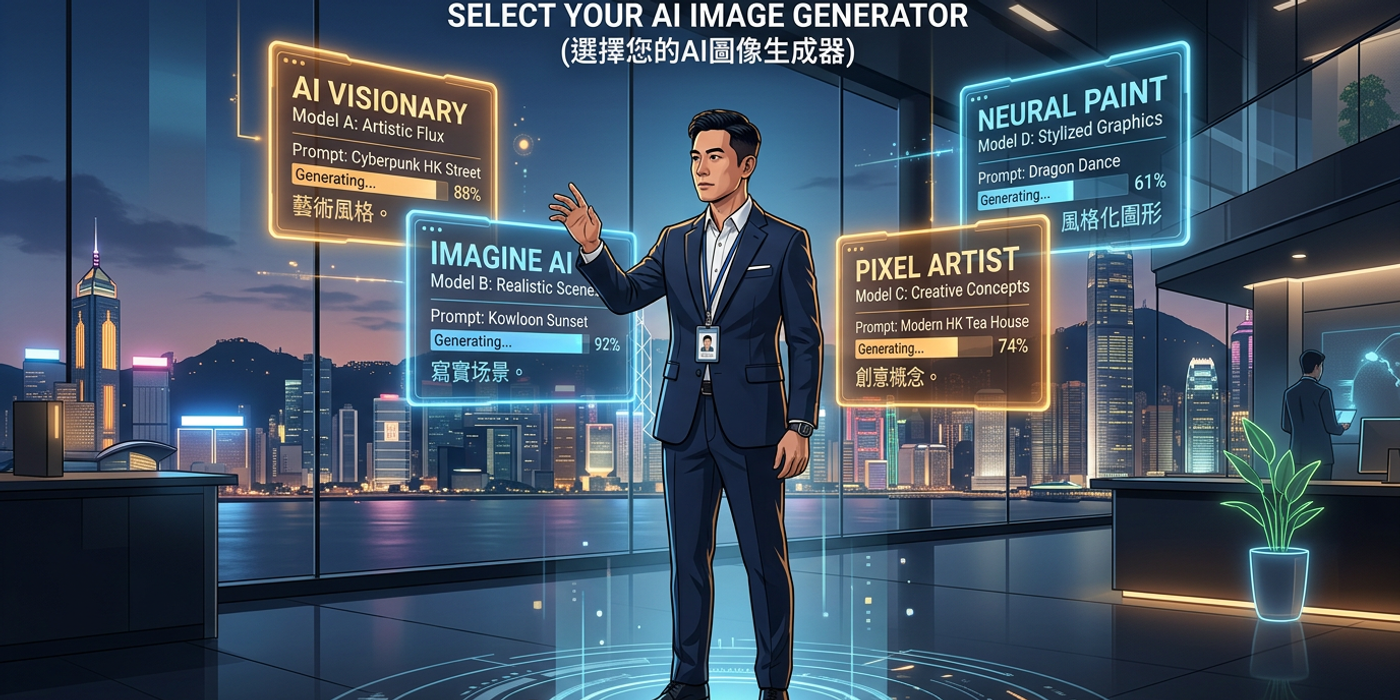
A strategic guide to choosing AI image models for Hong Kong businesses in late 2026, covering ChatGPT Images 2.5, Qwen-Image-2.1, and multi-model workflows.
Since the release of ChatGPT Images 2.5 and Qwen-Image-2.1 in September 2026, Hong Kong businesses face a more complex AI image tool landscape than ever. This guide cuts through the noise with a strategic decision framework for choosing the right model for your specific production workflow — whether you are producing e-commerce photography, social media content, or brand assets.
The Late 2026 AI Image Landscape Has Changed
The third quarter of 2026 brought a wave of new image generation models that fundamentally shifted the competitive dynamics. ChatGPT Images 2.5 introduced two specialized variants — Sketch for rapid ideation and Templates for brand-consistent outputs — making OpenAI a serious contender for production work. Qwen-Image-2.1 went open-weight, meaning Hong Kong businesses can now run enterprise-grade image generation on their own hardware without per-generation API costs.
FLUX Schnell continues to dominate real-time applications with sub-second generation speeds, while Nano Banana 2 remains the benchmark for photorealism. Microsoft MAI-Image-2.5 matched Nano Banana 2 on quality benchmarks while integrating directly with the Azure ecosystem that many Hong Kong enterprises already use. The key difference from even three months ago: there is no single "best" model anymore. Each tool has carved out a specific advantage, and the smart strategy is to match the model to the task rather than searching for a universal winner that does not exist anymore.
Strategy 1: Match Models to Output Type
Different business use cases demand different model strengths. For product photography, Nano Banana 2 and ChatGPT Images 2.5 Templates mode deliver the most consistent results with sharp detail and accurate brand color reproduction. For social media content where speed matters more than perfection, FLUX Schnell generates publishable images in under a second — ideal for A/B testing multiple creative variants in a single session.
For bilingual Hong Kong businesses creating content in both English and Chinese, Qwen-Image-2.1 handles Chinese text rendering natively without the garbled characters that Western-centric models often produce. This alone makes it worth evaluating for any Hong Kong brand producing Chinese-language marketing materials.
Strategy 2: Consider Total Cost of Operation
The per-generation API cost is only one part of the equation. A model that costs three cents per image but requires five regenerations to get the right result can be more expensive than a six-cent model that delivers on the first try. This regeneration cost is often invisible in budget planning but shows up clearly when you track total throughput per project. Add in post-production retouching when models produce artifacts, and the calculation shifts again.
Open-weight models like Qwen-Image-2.1 change the math entirely for businesses generating at scale. After the initial hardware investment, marginal costs drop to near-zero. For a Hong Kong agency producing ten thousand plus product images per quarter, the break-even point with API-based services is around three to four months.
Strategy 3: Build a Multi-Model Pipeline
The most efficient Hong Kong businesses in late 2026 do not pick one model — they build a pipeline. Use FLUX Schnell or ChatGPT Images 2.5 Sketch for rapid iteration and client feedback rounds. Once the creative direction is approved, switch to Nano Banana 2 or ChatGPT Images 2.5 Templates for final production. Reserve Qwen-Image-2.1 for any batch that requires Chinese text rendering.
This approach minimizes cost during the experimental phase while maximizing quality at delivery. Several Hong Kong agencies we have profiled report forty to sixty percent reduction in total image production costs after switching from single-model to multi-model pipelines.
Frequently Asked Questions
Q: Which AI image model is best for Hong Kong e-commerce product photography? A: Nano Banana 2 delivers the most consistent product shots. For catalog-scale production, Qwen-Image-2.1 offers the lowest marginal cost after initial setup.
Q: Is ChatGPT Images 2.5 professional enough for client work? A: Yes, especially the Templates mode which maintains brand consistency across generations. The Sketch mode is better for ideation than final delivery.
Q: How does Chinese text rendering compare across models? A: Qwen-Image-2.1 leads for native Chinese text rendering. Western models still produce garbled characters in most Asian-language prompts.
Q: Should I use FLUX Schnell or Nano Banana 2 for social media content? A: FLUX Schnell for volume and speed — ideal for A/B testing variants. Nano Banana 2 for hero assets and premium content needing maximum quality.
Q: What hardware do I need for open-weight image models? A: Qwen-Image-2.1 runs on consumer GPUs with 12GB VRAM. For agency-scale production, a workstation with 24GB or more VRAM is recommended.
Q: How often should Hong Kong businesses re-evaluate their AI image stack? A: Every four to six weeks. New models launch frequently, and what was best-in-class last month may no longer be the optimal choice.
Q: Can I combine multiple AI image models in one production workflow? A: Yes, and this is becoming the standard approach. Use fast models for iteration rounds and premium models for final output to balance speed with quality.