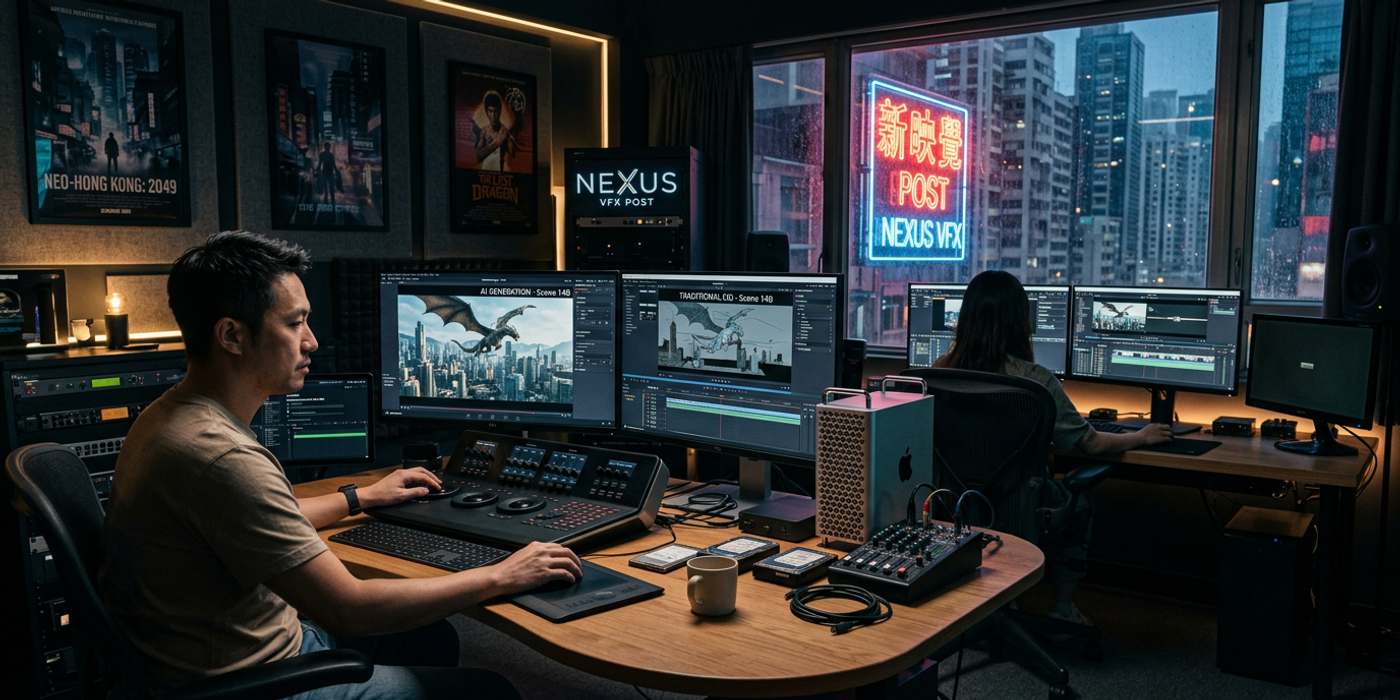
Hong Kong film studios now integrate AI tools directly into post-production and VFX pipelines. Here's how late 2026 reshapes hybrid workflows.
How Post-Production Workflows Have Changed in Late 2026
The shift from AI-as-pre-visualisation to AI-as-production-tool is the defining change in Hong Kong film post-production this year. Where mid-2026 workflows kept AI confined to storyboarding, concept art, and early pitching, the latest generation of video models now slots directly into editorial and VFX pipelines.
FLUX 3 Video, Seedance 2.5, and LTX-2.5 all deliver footage that matches broadcast specs at native resolutions. Hong Kong post houses have started feeding AI-generated clips directly into their DaVinci Resolve and After Effects timelines — not as placeholders, but as final elements. The key enabler is shot-level consistency: these models maintain lighting, colour, and composition across multiple generations, letting editors treat AI output as rushes rather than references.
Several Central-based post-production studios now run dedicated AI compute nodes alongside their render farms. A typical setup pairs an A100 cluster for FLUX 3 Video inference with the existing Teradici workstation pipeline. Editors toggle between AI-generated background plates and traditionally rendered CGI depending on the shot's complexity.
Where AI Replaces Traditional VFX — and Where It Complements
Understanding which tasks AI genuinely replaces versus which it complements is critical for HK studio heads planning their 2027 budgets.
AI-led replacement is strongest in three areas: background extension, transient B-roll, and colour-grade prototyping. Hong Kong studios producing commercial campaigns for brands like Lee Kum Kee or the Hong Kong Tourism Board routinely use AI to generate environmental variations of a hero shot — different times of day, weather conditions, or seasonal backdrops — without reshooting. A single Kling 3.0 generation of a Victoria Harbour establishing shot costs roughly 40 HKD in compute, compared to 3,500 HKD for a helicopter shoot and colourist day rate.
Complementary workflows dominate complex VFX. Character animation, multi-layer composites, and precise product shots still require human artists, but AI now handles the busywork. A VFX artist working on a Tsui Tsin-fa production described the shift as "removing the first three passes" — AI generates the base plate, the lighting reference, and the atmosphere, and the artist refines, composites, and polishes. The result is a 30–40 per cent reduction in per-shot turnaround without cutting creative control.
A growing middle ground is AI-assisted rotoscoping and masking. Seedance 2.5's native segmentation layer lets editors generate per-shot masks in seconds rather than minutes. This is a direct complement — the artist still reviews and adjusts every mask, but the repetitive manual labour drops substantially.
Navigating Hong Kong's Dual AI Ecosystem
Hong Kong occupies a rare position in late 2026: studios here can deploy both Chinese and Western video models without the licensing or latency barriers that constrain teams in other markets.
China-origin models like Alibaba's Wan3.0, ByteDance's Seedance 2.5, and Kling 3.0 offer competitive output with Cantonese-friendly prompt handling and lower inference costs on regional cloud providers. Western models — FLUX 3 Video, Veo 3.1, and LTX-2.5 — bring different stylistic strengths. FLUX 3 Video excels at photorealistic environments. LTX-2.5 leads in prompt adherence for action sequences. Veo 3.1 remains the benchmark for consistent character performance across long clips.
The practical consequence for HK production managers is a best-of-breed strategy rather than a single-model bet. A Wan3.0 establishing shot, a Veo 3.1 character sequence, and an LTX-2.5 action sequence can all live in the same timeline, graded to match in Resolve. The workflow complexity is lower than managing three different CGI rendering pipelines.
Practical Implications for Hong Kong Studios
Budget reallocation is the most immediate shift. Studios that spent 60 per cent of their post-production budget on traditional rendering are now closer to a 40–20 split between AI inference and manual VFX. The freed budget goes to more iterations, more creative risk-taking, and faster client review cycles.
Crew composition is evolving but not shrinking. The demand for prompt engineers, AI model operators, and AI-VFX bridge specialists is rising. Several Hong Kong film schools have introduced modules on AI post-production workflows for the 2026 academic year. The skillset being sought is not replacement of traditional artistry but augmentation of it — knowing which AI model to apply to which production problem.
Rapid prototyping is the unsung advantage. HK production companies pitching to HSBC or HKTB now deliver near-final-quality sample sequences within a single working day instead of a full week. The speed gain is reshaping how pitches are structured and how many creative directions a studio can afford to explore per proposal.
Frequently Asked Questions
Q: Which AI video models are Hong Kong studios using most in late 2026? A: FLUX 3 Video, Kling 3.0, Seedance 2.5, Veo 3.1, and LTX-2.5 are the five most deployed models in HK post-production. Each serves a different role, from establishing shots to character sequences.
Q: How much does AI video generation cost compared to traditional VFX? A: A single AI-generated establishing shot costs roughly 30–60 HKD in compute. The equivalent traditionally rendered or shot scene costs 2,000–5,000 HKD. Savings are greatest on background and B-roll work.
Q: Are VFX artists losing jobs to AI in Hong Kong? A: The pattern in 2026 is role evolution rather than replacement. Manual rote tasks shrink, but demand grows for artists who can operate AI tools and refine AI output. The total headcount in post-production has remained stable.
Q: Can AI-generated footage go directly into broadcast? A: Yes. FLUX 3 Video and Seedance 2.5 both output at 1080p and 4K with consistent quality across generations. Major HK production houses now use AI clips as final elements in broadcast commercials.
Q: How do Chinese and Western AI tools compare for HK productions? A: Chinese models (Seedance, Wan3.0, Kling) offer lower costs and stronger Cantonese prompt understanding. Western models (FLUX 3 Video, Veo, LTX) deliver different stylistic signatures. Most HK studios use a mix of both.
Q: What hardware do HK post houses use for AI video inference? A: Common setups include NVIDIA A100 and A6000 clusters for FLUX and Veo inference, with H100 nodes increasingly deployed for LTX-2.5 and Seedance 2.5 workloads. Cloud inference via regional providers is also popular.
Q: How long does it take to train a team on AI post-production workflows? A: Most Hong Kong studios report 2–4 weeks for experienced VFX artists to reach productive speed with AI tools. The learning curve is shorter for artists already familiar with Resolve or After Effects.