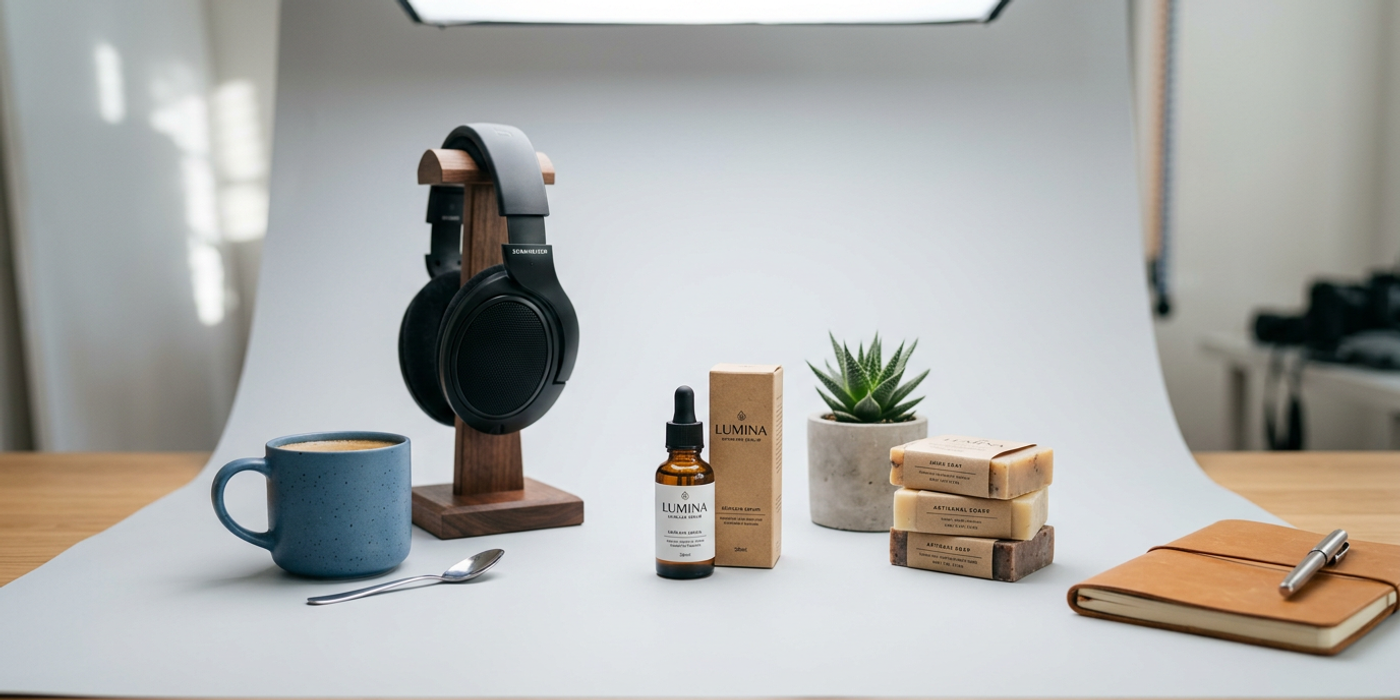
Learn how Hong Kong e-commerce brands use AI product photography in 2026 — from model selection to prompt workflows, cost savings, and brand consistency tips.
Product photography has always been a bottleneck for e-commerce brands in Hong Kong. Between studio rentals, photographer rates, and reshoots for every new SKU, the cost adds up fast. In 2026, AI image generation has matured to the point where Hong Kong brands can create professional-grade product photos in minutes — no studio, no lighting rig, no photographer needed. Here is how to use AI product photography effectively, which tools deliver the best results, and what every e-commerce brand should know before diving in.
Why AI Product Photography Is a Game-Changer for Hong Kong E-Commerce
Hong Kong's e-commerce landscape moves fast. Brands on HKTVmall, Shopee, and Carousell need fresh product images constantly — new arrivals, seasonal promos, A/B testing visuals. Traditional photography cannot keep up at scale. A single photoshoot costs HK$3,000-8,000 and takes days. AI brings that down to minutes and cents per image.
The key shift in 2026 is photorealism. Models like Seedream 4, Nano Banana 2, and Meta Muse Image now produce images indistinguishable from studio photography for beauty, fashion, electronics, food, and home goods. AI can simulate different backgrounds, lighting, angles, and even lifestyle contexts (a handbag "on the street in Central" or dumplings "on a table in a Cha Chaan Teng") without physical staging.
For Hong Kong brands, this means faster time-to-market, lower production costs, and the ability to run more visual experiments. A fashion brand can generate the same garment on different models, in different settings, at different times of day — all from a single product photo and a well-written prompt.
Which AI Image Models Deliver the Best Product Photography in 2026
Not all AI image models are created equal when it comes to product photography. The best models for e-commerce share three traits: high photorealism, reliable composition control, and strong text rendering (for adding product labels or packaging text).
Seedream 4 from ByteDance is currently the top performer for general product photography. Its strength lies in understanding fine details — fabric textures, metallic reflections, glass transparency. It handles complex backgrounds without distorting the product, which is critical for Hong Kong brands selling premium goods where presentation matters.
Nano Banana 2 excels at consistency across a batch. If you need 50 product images that all share the same lighting and background style, Nano Banana 2 delivers the most uniform results. This is ideal for catalogue pages where visual consistency builds brand trust.
Meta Muse Image offers the best integration with existing product data. Because it runs on Meta's infrastructure, brands selling through Instagram and WhatsApp Shops can generate product images directly within their ad management workflow. The trade-off is less control over fine details compared to Seedream 4.
Flux Schnell remains the fastest option for quick turnaround needs — promotional banners, social media posts, and temporary campaign assets where speed matters more than absolute quality.
For Hong Kong brands, the practical recommendation is to use Seedream 4 or Nano Banana 2 for main catalogue images and Flux Schnell for high-volume, lower-stakes assets like social media variants.
How to Create AI Product Images That Actually Sell
Getting great results from AI product photography comes down to three things: input quality, prompt structure, and workflow.
Start with a clean reference image. AI models work best with a good base photo. Take one well-lit, plain-background shot of your product — this is your anchor. Most tools (Seedream 4 in particular) support reference image workflows where you upload the base photo and describe the desired setting. Shoot 20 products in a lightbox once, then generate hundreds of lifestyle variations.
Structure your prompts for commercial photography output. Generic prompts like "a bottle of skincare on a table" produce generic results. Commercial-grade prompts specify lighting (soft studio, golden hour, rim light), context (bathroom shelf, luxury boutique window), and camera style (50mm lens, shallow depth of field, macro detail). The difference between "a watch on a surface" and "a luxury watch on a marble surface, soft overhead studio lighting, shallow depth of field, 85mm lens" is the difference between amateur and commercial.
Build a style library. Rather than writing new prompts from scratch each time, create reusable prompt templates with your brand's visual identity baked in. Include your brand's preferred lighting, colour palette, composition rules, and background preferences. Each time you add a new product, you slot it into the template. This maintains consistency across your catalogue and dramatically speeds up production.
Common Pitfalls and How to Avoid Them
AI product photography is powerful, but has sharp edges. The most common mistake Hong Kong brands make is treating AI output as final rather than a starting point. Even the best models generate artefacts — extra fingers, distorted text, uneven lighting. Build a quick QC step into your workflow. A 10-20 second visual scan catches 95 per cent of obvious issues.
Another pitfall is background overfitting. AI models trained primarily on Western product photography may struggle with Hong Kong-specific contexts — proper dim sum steam baskets, MTR interiors, Cha Chaan Teng aesthetics. When generating localised lifestyle images, include specific Hong Kong references in your prompt and expect to iterate more than you would for generic Western settings.
Finally, avoid over-reliance on a single model. Most brands in 2026 use 2-3 AI image models in rotation, picking the best output from each for different product categories. Seedream 4 for beauty and fashion, Nano Banana 2 for electronics and home goods, Flux Schnell for rapid social media variants. Model-switching takes minutes and dramatically improves overall quality.
Frequently Asked Questions
Q: Is AI product photography cheaper than traditional photography? A: Yes. A traditional product photoshoot costs HK$3,000-8,000 per session. AI generation costs roughly HK$0.10-0.50 per image.
Q: Can AI product images be used on HKTVmall, Shopee, and other HK platforms? A: Yes. All major Hong Kong e-commerce platforms accept AI-generated product images. Follow each platform's image guidelines for resolution and aspect ratio.
Q: How do AI product images handle Chinese text on packaging? A: Current models handle short Chinese phrases well. Seedream 4 and Nano Banana 2 can render labels, but longer text often contains errors. Add complex text in post-production.
Q: Can I generate the same product in different colours? A: Yes. Upload a reference image and change the colour description in your prompt. Results are best when the colour change doesn't affect texture or material.
Q: How do I ensure brand consistency across AI-generated product images? A: Build a prompt template with your brand's lighting, colour palette, background, and composition rules. Apply the same template across your entire catalogue.
Q: Do I need technical skills to use AI product photography tools? A: Basic prompt writing is enough to start. Most platforms use a simple upload-and-describe workflow. Advanced features like style libraries require some learning.
Q: What resolution do AI product images output at? A: Most models output at 2048x2048 or higher. Seedream 4 and Meta Muse Image support up to 4096x4096, sufficient for e-commerce and print advertising.
Q: Can AI generate lifestyle images with models holding products? A: Yes, for simple poses. A hand holding a phone or a model wearing a necklace works well. Complex multi-model scenes still benefit from human photography.