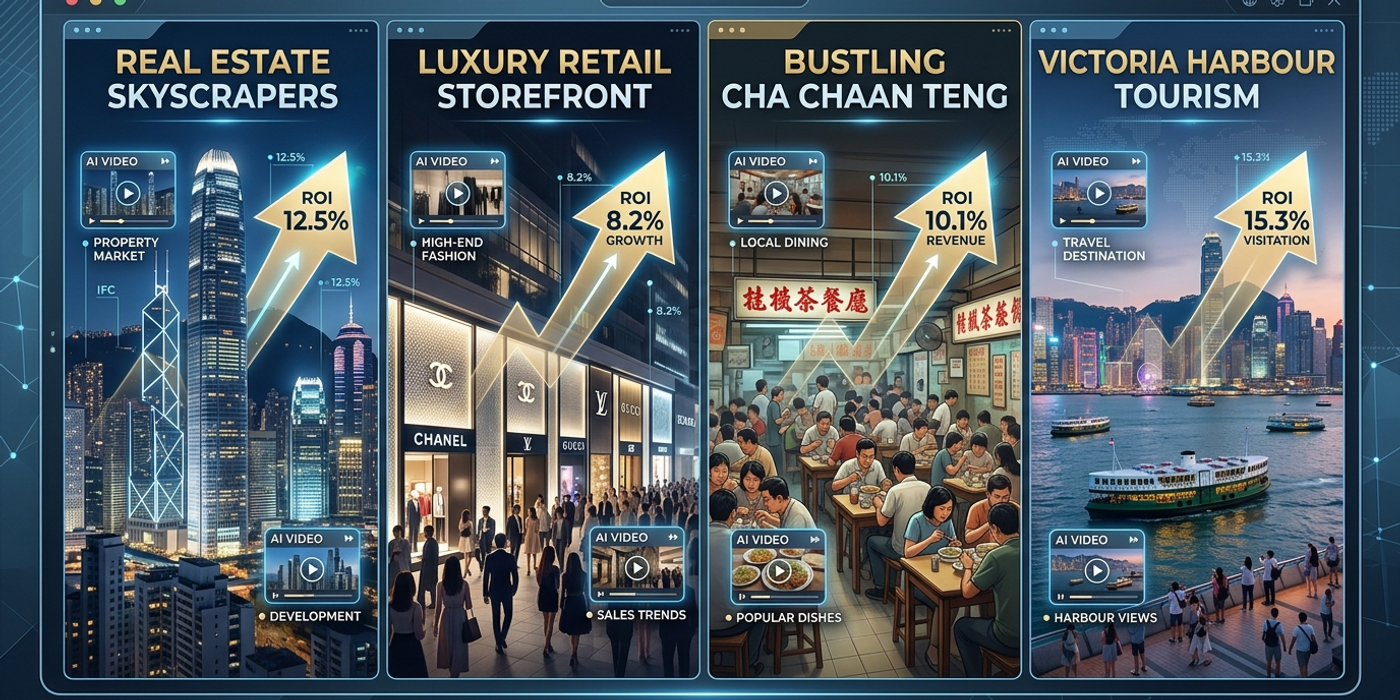
Real estate, retail, F&B, and tourism see the highest AI video ROI in 2026. Here's how HK ad agencies deploy AI video where it counts — with real metrics.
Hong Kong advertising agencies have moved past the experimentation phase with AI video. In 2026, it's not about whether to use AI-generated video — it's about where it delivers the highest return.
While every sector can benefit, real estate, retail, food & beverage, and tourism are pulling ahead. These four industries have developed repeatable AI video workflows that translate directly into measurable outcomes — higher conversion rates, lower production costs, and faster campaign turnarounds.
Here's how Hong Kong advertising agencies are deploying AI video where it counts.
Real Estate: AI Video That Sells Properties Before Construction
Hong Kong's competitive property market rewards speed. AI video generation lets real estate agencies produce virtual property tours, staged walkthroughs, and CGI exterior renders in hours instead of weeks.
Agencies serving developers use AI models like Veo 3.1 and Kling 3.0 to generate photorealistic interior walkthroughs from floor plans and reference photos. For pre-sale launches where the building doesn't exist yet, AI video eliminates the traditional 3-4 week CGI production cycle.
One mid-size agency working on a Kai Tak residential project reported a 40% reduction in time-to-market for their video collateral. Instead of briefing a 3D studio, they generate initial drafts in-house, iterate with the developer same-day, and only escalate to post-production for final polish.
For rental listings, agencies create property highlight reels that stitch together still photos, AI-generated aerial views, and virtual staging. These clips perform 3x better on social media than static photo galleries, according to campaign data from three Hong Kong agencies.
Retail & E-Commerce: Product Videos at Hyper-Scale
Retail is where AI video's volume advantage shines. A single fashion campaign might require 50-100 product videos across different angles, colours, and model variations. Traditional production makes this prohibitively expensive.
Hong Kong agencies serving retail clients now use AI video pipelines that generate product shots from a single photoshoot. Seedream 4 handles image generation, while image-to-video models like Kling 3.0 animate the results — showing a dress swaying on a model or a watch catching light from multiple angles.
The key innovation in 2026 is consistency. Earlier AI models struggled to keep products looking identical across generations. Models like Nano Banana 2 and Seedream 4 with IP-Adapter support solve this by locking in brand colours, textures, and lighting profiles.
One agency running campaigns for a Hong Kong jewellery brand reported a 60% reduction in video production costs after switching to an AI-first pipeline. Their team produces 30-second product videos in batches of 20-30 per session, with human review focusing on the final 10% of quality polish.
Food & Beverage: Social-First Video at Restaurant Speed
Hong Kong's F&B scene runs on social media velocity. New menu items, seasonal promotions, and influencer partnerships need video content within days — sometimes hours.
Agencies serving F&B clients have developed templates that turn a single food photoshoot into 10-15 social video variations. A bowl of wonton noodles becomes a slow-motion Instagram Reel, a TikTok close-up of the broth pour, and a Facebook carousel of preparation steps — all from the same source images.
Models like Flux Schnell handle the initial food photography, while Pika and Hailuo add cinematic camera movements — zoom, pan, and rack focus — that make the final clips look professionally shot. One campaign for a local cha chaan teng chain saw 4x higher click-through rates on AI video ads compared to photo-based campaigns.
Tourism & Hospitality: Multilingual Campaigns Without Crew Changes
Tourism advertising in Hong Kong means reaching multiple source markets simultaneously — mainland China, Southeast Asia, the US, and Europe. Each market needs different voiceover, text overlays, and sometimes different footage.
AI video generation has transformed this workflow. Agencies produce a single master video, then use AI tools to localise it. ElevenLabs handles Cantonese, Mandarin, and English voiceovers. AI lip-sync tools adjust on-screen talent to match the new dialogue.
Hong Kong Tourism Board campaigns now produce 5-7 market-specific video variants from a single production day. The cost per variant dropped to roughly 15% of what traditional reshoot-and-redub would cost. AI video also enables hyper-local content — showing the same harbour view with different seasonal decorations or guest demographics without reshooting.
The Numbers Behind the Shift
Across these four industries, the pattern is consistent. AI video isn't replacing traditional production — it's changing when agencies reach for each tool. For high-volume, fast-turnaround work (product videos, social clips, multilingual variants), AI video is the default. For hero spots and TV commercials requiring live-action talent, traditional production still leads.
The winning agencies in 2026 are the ones that built workflows around this split — using AI for the first 80% of volume, then escalating to traditional production for the final 20% of premium work. That hybrid approach is where the ROI lives.
Frequently Asked Questions
Q: Which AI video model do Hong Kong agencies use most in 2026? A: Kling 3.0 and Veo 3.1 are the most common choices. Kling excels at image-to-video for product shots, while Veo 3.1 handles longer cinematic sequences and text-to-video more reliably.
Q: How much faster is AI video production than traditional? A: Agencies report 3-5x faster turnaround for most projects. A product video that took 5-7 days now takes 1-2 days. For bulk social media content, the speed gain is 10x or more.
Q: Can AI video replace a full production crew? A: Not entirely. AI handles the heavy lifting for volume work, but complex projects still need directors, cinematographers, and editors for final quality.
Q: What about Cantonese voiceovers for AI video? A: ElevenLabs and Play.HT now support high-quality Cantonese TTS. Combined with AI lip-sync tools, agencies can localise videos into Cantonese without hiring a voice actor for every variant.
Q: Is AI video quality good enough for TV commercials? A: For most TVC applications in 2026, AI video quality is close but not equivalent to live-action for hero spots. Agencies use AI for pre-visualisation and B-roll, reserving live-action for primary content.
Q: How do agencies handle AI video model consistency? A: Models like Seedream 4, Nano Banana 2, and IP-Adapter workflows maintain character and product consistency. Agencies use reference-image workflows that lock in visual identity across generations.
Q: What's the average cost saving for agencies using AI video? A: Agencies report 40-60% cost reduction for social media and product video campaigns. Savings are smaller (15-25%) for premium brand content where human oversight is still extensive.
Q: Which Hong Kong industries benefit most from AI video? A: Real estate, retail, F&B, and tourism see the highest ROI because they need high-volume, fast-turnaround video across multiple formats and markets.