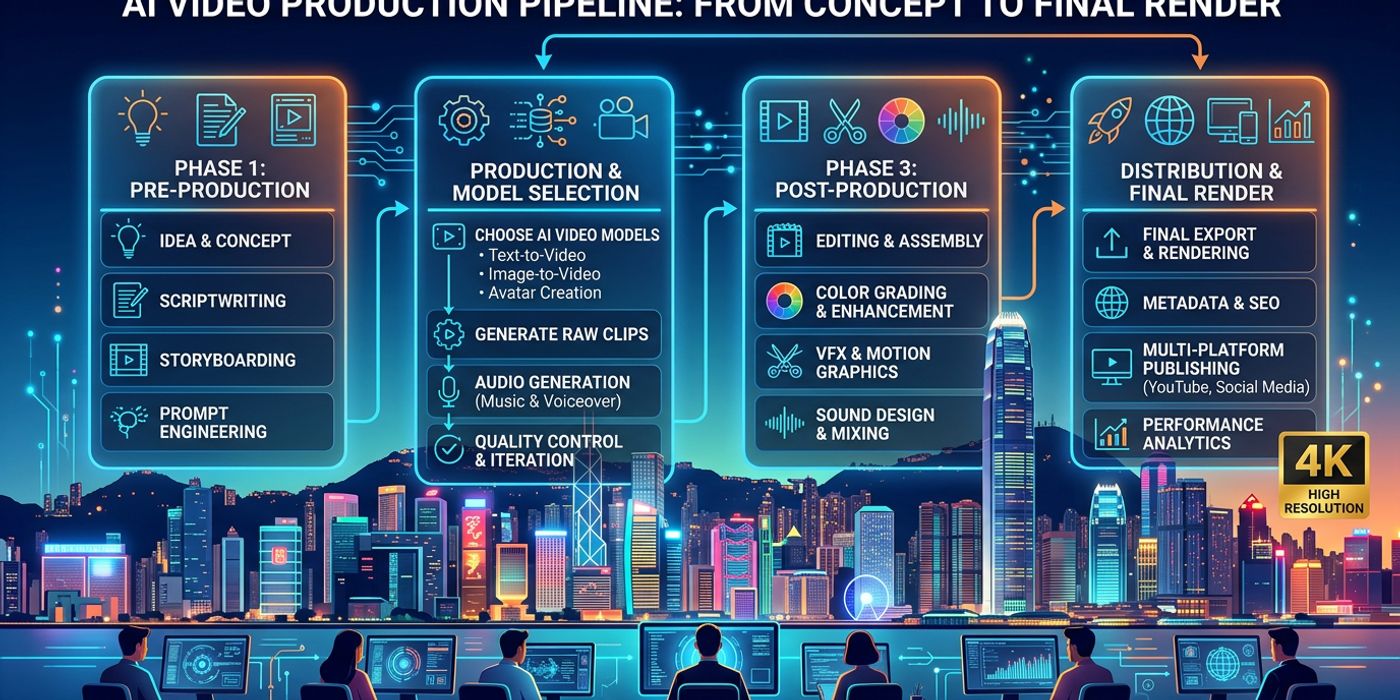
Build a complete AI video production workflow from concept to render. Pre-production, model selection, post-production, and distribution for Hong Kong creators.
Building AI video for a Hong Kong client today involves more than picking a model and typing a prompt. The late-2026 landscape offers specialised tools for every production phase — pre-production script drafting, storyboard generation, multi-model video synthesis, AI audio design, and post-production finishing. This guide walks through the complete workflow, from concept to final render, with the best models and practices for each stage.
Pre-Production: Concept, Scripting, and Storyboarding
The most efficient AI video projects start with structured pre-production. Drafting a clear creative brief — target audience, platform (Instagram Reels, YouTube, OOH), tone, and key message — determines which models and outputs fit later.
Scripting with AI assistance: ChatGPT and Claude can generate video scripts from a brief, but the best results come from feeding them examples of your brand's past content. Hong Kong-specific cues matter: bilingual Cantonese-English dialogue, local cultural references, and platform-native pacing (15-second Reels vs 60-second YouTube ads).
Storyboard generation: Models like Veo 3.1 and Kling 3.0 support keyframe-based generation, where you supply reference images that define transitions between scenes. For rapid iteration, tools like Pika's storyboard mode let you sketch scene compositions with text prompts before committing to full renders. This phase alone can cut production time by 40% by catching pacing issues early.
Model Selection by Production Phase
Not every AI video model excels at every stage. Matching the model to the production phase saves credits and improves output quality.
Scene generation (core footage): Veo 3.1 leads for cinematic, high-fidelity clips with complex motion. Kling 3.0 offers faster generation ideal for social media volume. Seedance 2.5 generates native stereo audio alongside video, saving a post-production step for ads that don't need custom scoring. FLUX 3 Video produces 20-second clips with native audio, suited for longer-form brand stories.
Scene extension and bridging: Gemini Omni 1.1 Flash excels at extending existing clips — it adds 360p draft mode for quick iterations and smarter scene extension for seamless transitions between generated clips.
Voiceover and audio: ElevenLabs Eleven v4 delivers more expressive voice acting for narration. Qwen Audio 3.1 offers five new voice models at 95% lower pricing, making bulk voiceover production viable for agency workflows. For background music, ElevenLabs Music v2.5 is free for HK creators, while Suno v6 brings licensed music from Warner, BMG, and Believe.
Post-Production: Editing, Audio, and Finishing
Raw AI video almost never drops straight into a final edit. Post-production remains the phase where human craft adds the most value.
Editing and assembly: Traditional NLEs (Premiere, DaVinci Resolve) remain essential for pacing, transitions, and layering. The difference in late 2026 is that AI-generated footage comes in consistent durations and resolutions, making assembly faster. Use ChatGPT Images 2.5 or GPT-Image-2 for generating title cards, lower thirds, and thumbnail overlays in a matching visual style.
Audio finishing: For Hong Kong ads targeting local audiences, Cantonese voiceover quality matters. Gradium TTS excels on hard-case accuracy for Cantonese, while Cartesia Sonic-3.6 tops voice rankings for natural intonation. If your brief requires licensed music, Suno v6's Warner/BMG catalogue covers background tracks without copyright risk.
Colour grading and finishing: Many HK agencies now run a consistency pass — generating frames at 4K with FLUX 3 Image or MAI-Image-2.5, then using reference-based colour matching to unify AI clips with traditionally shot footage. The finishing pass is also the right stage to add brand-consistent overlays using the same model that generated the core video.
Distribution and Performance Tracking
AI video production doesn't end at export. Hong Kong creators serving clients need platform-optimised outputs and performance data to justify the AI workflow.
Platform-native exports: Each platform has different technical requirements. Instagram Reels favour 9:16 vertical, 30-60 seconds. YouTube prefers 16:9 horizontal, longer runtime. WeChat Moments and Douyin (TikTok China) have their own codec and bitrate preferences. Generate clips at native resolution and aspect ratio per platform rather than upscaling or cropping later.
A/B testing at scale: The low marginal cost of AI video makes A/B testing practical. Generate 3-5 variants of a 15-second ad with different openings, voiceover tones, or pacing. Run them as Instagram Reels ads for 48 hours and let the metrics guide which variant your client doubles down on. This data-driven approach is one of AI video's strongest advantages over traditional production.
Frequently Asked Questions
Q: What's the difference between a production workflow and a production checklist? A: A checklist tells you what to consider before, during, and after production. A workflow is the actual step-by-step process — the order of operations for taking a project from brief to delivery.
Q: Which AI video model should I start with for Hong Kong social media content? A: Kling 3.0 for speed and volume, or Seedance 2.5 if you want native audio output. Both handle short-form social content well without requiring extensive post-production.
Q: Can AI video replace traditional production entirely for short-form ads? A: For most Hong Kong brands, AI video replaces the camera and lighting crew but not creative direction, editing, or client management. The workflow still needs a producer who understands pacing, brand identity, and platform strategy.
Q: How do I ensure brand consistency across multiple AI-generated clips? A: Use reference images for every scene, generate a style frame first, and run a colour consistency pass in post-production. Models like Veo 3.1 and FLUX 3 Video support image-to-video, which anchors the visual style.
Q: What audio models work best for Cantonese voiceover in AI video? A: Gradium TTS leads on hard-case Cantonese accuracy for dialect-specific content. Cartesia Sonic-3.6 offers more natural intonation for standard Cantonese. ElevenLabs Eleven v4 handles bilingual Cantonese-English scripts well.
Q: How long does a typical AI video production workflow take from concept to delivery? A: A 30-second Reel can go from brief to final render in 2-3 days with AI tools. A 60-second YouTube ad with custom audio typically takes 5-7 days, comparable to traditional timelines but at roughly one-third the cost.
Q: Should I generate one long clip or multiple short clips for a 60-second ad? A: Multiple short clips (10-15 seconds each) give you more control over pacing and transitions in post-production. Veo 3.1 and FLUX 3 Video generate clips up to 20-30 seconds, which you then assemble and transition in your NLE.
Q: What's the most common mistake when adopting AI video workflows? A: Skipping pre-production. The fastest way to waste credits is generating footage without a clear brief. Draft the script, define the visual style, and storyboard key frames before generating a single clip.