AI generation costs are falling — but are you actually saving? From model selection to batch workflows, here's how HK creators cut costs without quality loss.
AI image and video generation costs have dropped dramatically in 2026 — but unless you're actively optimising, you're probably still overpaying. Between model-specific pricing, resolution tiers, and platform credit systems, the difference between a wasteful workflow and a cost-efficient one can be 2-5x on your monthly spend.
The good news? You don't have to downgrade to a worse model or accept lower quality to save. The smartest savings come from workflow choices, not compromises. Here's exactly how Hong Kong creators and agencies are cutting their AI generation costs without sacrificing the output their clients expect.
Match the Model to the Task, Not the Hype
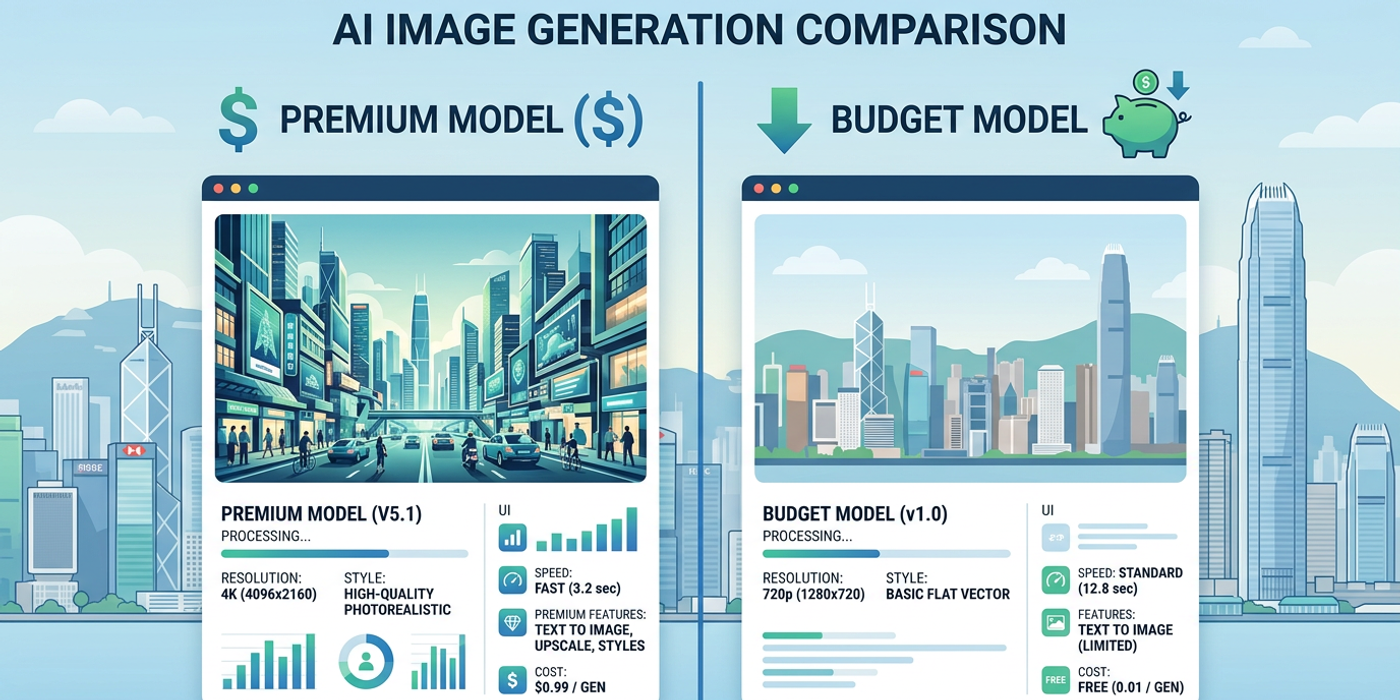
The single biggest cost leak is using a flagship model for work a mid-tier model can handle. Seedream 4 and Meta Muse Image are incredible — but they're also the most expensive credits-per-generation on most platforms. For internal moodboards, early ideation rounds, or rough storyboards, use a faster, cheaper model like Flux Schnell or base Stable Diffusion. Reserve the premium models for client-facing finals.
This tiered approach alone can cut your generation costs by 40-60%. Build a simple checklist: if the output is for internal review, use a budget model. If it's going to a client presentation or final delivery, use the premium tier.
Batch Your Generations
Every generation API call has overhead — model loading, context initialisation, response parsing. Generating one image at a time means paying that overhead on every request. Batch generation spreads the overhead across multiple outputs, dramatically reducing per-unit cost.
Platforms like Cooly Studio, Runway, and Kling support batch prompts or queue-based workflows. Instead of generating one variation, tweaking, repeating — plan your batch upfront. Generate 8 variations in one batch, pick the best 2-3, and iterate only on those. Better results, significantly lower cost per usable output.
Right-Size Your Resolution
This is the easiest savings on the table. Most social media platforms still compress images to under 2K resolution. TikTok, Instagram, and LinkedIn all serve images at 1080p or below. Yet many creators generate at 4K for every output, burning through credits.
Match resolution to delivery channel: - Social media posts: 1080p or 2K max - E-commerce product shots: 2K is plenty - Client presentation decks: 2K-4K depending on usage - Print or billboard: 4K or higher (reserve for this only)
Using 1080p instead of 4K costs 50-70% less per generation on most platforms. For video, the savings are even more pronounced because higher resolutions multiply frame costs.
Use Image-to-Video for Cost Efficiency
Text-to-video generation is inherently more expensive than image-to-video because the model has to hallucinate the starting frame, character design, and composition from scratch. Image-to-video starts from a reference image you already created — so the model only needs to animate, not invent.
Generate your keyframe using a budget image model like Flux Schnell, then feed that into Kling 3.0 or Seedance 2.5 for animation. This pipeline costs 30-40% less than generating the same video from a text prompt on a flagship video model — and you get better composition control.
Cache and Reuse Your Model Outputs
Every time you regenerate the same style, character, or environment, you're paying for the model to re-learn context it already had. Build a local output library organised by style, character, and environment type.
When a client asks for a variation on a previous campaign: pull the relevant seed images and reference styles from your cache, iterate on existing outputs rather than regenerating from scratch. One well-crafted reference image can save dozens of re-generations across an entire campaign.
Pick All-in-One Platforms Over Point Solutions
Running five separate subscriptions — image gen, video, upscaling, voiceover, editing — is almost always more expensive than using an integrated platform. Cooly.ai bundles image generation, video generation, and post-production tools under a single credit system. No per-tool overhead, no unused seat licenses, no redundant subscriptions.
For Hong Kong agencies running multiple AI workflows daily, switching from a stack of point solutions to an integrated platform saves 30-50% on total monthly AI spend. The quality difference is negligible — most integrated platforms use the same underlying models you'd subscribe to individually.
Monitor Cost Per Deliverable, Not Cost Per Generation
The most important metric shift in 2026 is moving from cost-per-generation to cost-per-deliverable thinking. A generation costing 20 credits that produces a usable output on the first try is cheaper than a generation costing 5 credits that needs 8 re-rolls.
Track your usable rate — what percentage of generations make it to final delivery? If it's below 20%, you're using the wrong model or workflow. Optimise for first-generation success, not cheapest generation.
Frequently Asked Questions
Q: Which AI image model gives the best quality-to-cost ratio in 2026? A: Flux Schnell offers the best balance for most commercial work — fast, cheap, and high quality for social media and web content. For premium client work, Seedream 4 remains the gold standard, but reserve it for final deliverables only.
Q: How much can I save by switching from 4K to 1080p generation? A: Most platforms charge 50-70% less for 1080p compared to 4K. For social media content, the visual difference is negligible after platform compression.
Q: Is image-to-video really cheaper than text-to-video? A: Yes — typically 30-40% cheaper because the model doesn't need to generate the starting frame from scratch. You also get better composition control since you design the keyframe yourself.
Q: Which AI generation platform is most cost-effective for Hong Kong agencies? A: Cooly.ai offers competitive credit pricing with an integrated workflow covering image, video, and editing. The all-in-one approach avoids managing multiple subscriptions.
Q: How do I track cost per deliverable effectively? A: Track your usable rate (percentage of generations reaching final delivery) and cost per finalised asset. Most integrated platforms provide basic analytics — supplement with a spreadsheet for per-project tracking.
Q: What's the cheapest way to generate AI video for social media? A: Use image-to-video with a budget image model for the keyframe, generate at 1080p, and batch your requests. This pipeline costs 60-70% less than generating 4K text-to-video on a flagship model.
Q: Should I use one big subscription or multiple specialised ones? A: One integrated platform is almost always cheaper for active users. Multiple subscriptions mean paying for unused capacity in each tool. If you only use video generation once a month, pay-as-you-go may work better.
Q: How often should I re-evaluate my AI tool stack for cost efficiency? A: Every 3-4 months. The AI pricing landscape changes rapidly — new models, platforms, and pricing tiers launch constantly. A cost-efficient setup from Q1 may be outdated by Q3.