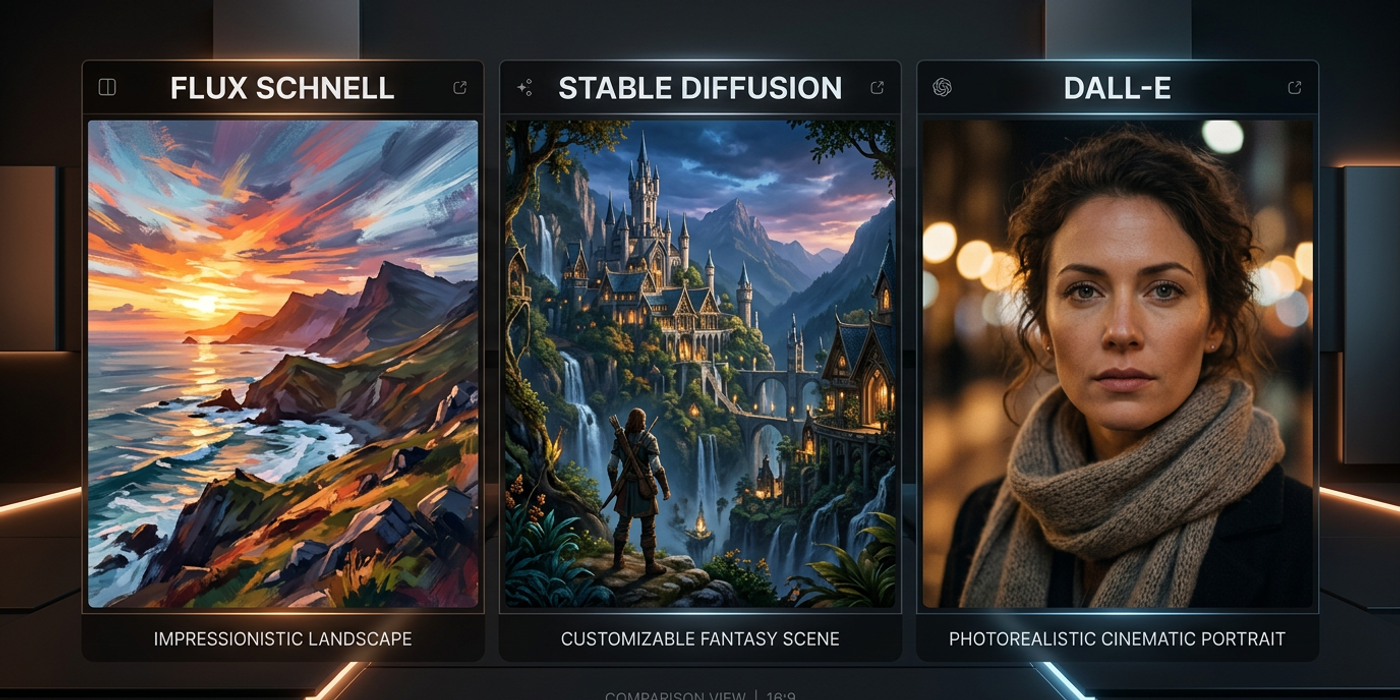
Compare Flux Schnell, Stable Diffusion, and DALL-E head-to-head in 2026. Which AI image model wins on speed, and which delivers the best quality? A practical comparison for Hong Kong creators, agencies, and marketers.
In 2026, choosing the right AI image model is no longer about which one can "generate a picture." Every major model can do that. The real question is: do you need speed, or do you need quality?
Flux Schnell, Stable Diffusion, and DALL-E represent three very different philosophies. One is built for raw speed. One is built for total control. One is built for out-of-the-box perfection. And the right choice depends entirely on what you're trying to create.
This guide breaks down each model's strengths, weaknesses, and best use cases — so you can stop guessing and start generating.
Flux Schnell — Built for Speed
Flux Schnell (from Black Forest Labs) is the Formula 1 of AI image generation. It's designed to produce high-quality images in 1–2 seconds, making it the fastest dedicated image model available on Cooly Studio in 2026.
Key strengths:
- Blazing fast inference — ideal for rapid iteration, moodboarding, and exploring visual directions - Good quality at high speed — handles complex prompts surprisingly well for its speed tier - Efficient for batch work — generate dozens of variations in seconds, not minutes - Low cost per generation — built for volume
Where it falls short:
- Less fine detail than slower models, especially in faces, hands, and intricate textures - Limited prompt nuance — very detailed or subtle prompts can lose fidelity - No advanced control features — no ControlNet, LoRA, or inpainting support in its base form
Best for: Rapid prototyping, social media content, moodboarding, early-stage creative exploration, and any workflow where volume and speed matter more than pixel-perfect output.
Stable Diffusion — The Customization King
Stable Diffusion (SDXL, SD3, SD3.5) remains the most customizable image generation ecosystem in 2026. Its open-source foundation means a vast community of tools, fine-tunes, and extensions.
Key strengths:
- Unmatched flexibility — ControlNet, LoRAs, IP-adapters, and thousands of community models - Fine-tuned variants for every style — anime, photorealistic, architectural, product photography, and more - Full control over every parameter — seed, CFG scale, scheduler, steps, denoising strength - Offline capable — runs locally on consumer GPUs
Where it falls short:
- Slower than Flux Schnell — typical generations take 5–15 seconds depending on model size and settings - Steeper learning curve — mastering prompts, parameters, and extensions takes time - Quality varies by checkpoint — a poorly chosen model gives poor results; finding the right one takes experimentation - Prompt adherence can be inconsistent — especially with complex compositions or specific text
Best for: Production work where you need precise control, specialised styles (product photography, architectural viz, character design), and workflows that benefit from community extensions and fine-tuned models.
DALL-E 3 — Quality First
DALL-E 3 (OpenAI) takes a different approach entirely. It prioritises prompt comprehension and output quality above everything else — speed and customization are secondary.
Key strengths:
- Best-in-class prompt adherence — DALL-E 3 understands complex, multi-part prompts better than any other model - Superior text rendering — generates legible text in images (signs, labels, product packaging) far more reliably than competitors - Excellent photorealism — skin, lighting, materials, and depth all look natural straight out of the box - Minimal prompt engineering needed — describe what you want naturally, and it delivers
Where it falls short:
- Slowest of the three — 10–30 seconds per generation, plus API latency - Most expensive per generation — not ideal for high-volume or iterative workflows - Least customizable — no ControlNet, no LoRAs, no fine-tuning. You work within OpenAI's boundaries - Content restrictions — stricter safety filters than open-source alternatives
Best for: Client-facing assets, polished marketing materials, photorealistic hero images, and any project where "getting it right in one shot" matters more than iteration speed.
Head-to-Head: Which Wins Where?
| Criteria | Flux Schnell | Stable Diffusion | DALL-E 3 | |---|---|---|---| | Generation speed | ⚡ 1–2s | 🐢 5–15s | 🐌 10–30s | | Image quality (default) | Good | Very good (depends on model) | Excellent | | Customizability | Low | Maximum | Minimum | | Prompt adherence | Moderate | Variable | Best | | Cost per image | Low | Low–Medium | Higher | | Text in images | Average | Average | Excellent | | Learning curve | Easy | Steep | Easy | | Batch / volume work | Excellent | Good | Poor |
Which Model Should You Choose in 2026?
Choose Flux Schnell when: You need volume — moodboards, social media batches, rapid iterations, or early-stage exploration. It's your go-to for speed-to-value ratio.
Choose Stable Diffusion when: You need control — branded product photography, character consistency across generations, architectural visualisation, or any project where you want to fine-tune the model itself. Pair it with ControlNet for composition control or LoRAs for consistent styles.
Choose DALL-E 3 when: You need polish — client presentations, final campaign assets, hero images, or any scenario where the image must be right on the first try. Its prompt comprehension is unmatched.
Best strategy for Hong Kong creators: Use all three in a pipeline. Start with Flux Schnell for rapid ideation, switch to Stable Diffusion for refinement and control, and finish with DALL-E 3 for the final polished output. Cooly Studio lets you switch between all three models in the same workspace — no need to juggle multiple tools.
Frequently Asked Questions
Q: Which AI image model is the fastest in 2026? A: Flux Schnell is the fastest dedicated image model, generating images in 1–2 seconds. It's ideal for rapid iteration and high-volume work.
Q: Is DALL-E 3 better than Stable Diffusion for photorealism? A: DALL-E 3 produces excellent photorealistic results out of the box with minimal prompting. Stable Diffusion can match or exceed DALL-E 3's photorealism, but only with the right fine-tuned model and expert prompt engineering.
Q: Can I use all three models in one workflow? A: Yes — Cooly Studio supports Flux Schnell, Stable Diffusion variants, and DALL-E 3 in a single interface. You can switch between them without leaving your workspace.
Q: How much do these models cost per image? A: Flux Schnell is the cheapest at roughly $0.002–0.004 per image. Stable Diffusion varies ($0.003–0.01 depending on resolution and steps). DALL-E 3 is the most expensive at $0.04–0.08 per image.
Q: Which model is best for generating text in images? A: DALL-E 3 is significantly better at rendering legible text in images (signs, labels, product names). Flux Schnell and Stable Diffusion both struggle with text accuracy.
Q: Does Stable Diffusion require a powerful GPU? A: Stable Diffusion can run on consumer GPUs with 8GB+ VRAM, but newer models like SD3.5 benefit from 16GB+. On Cooly Studio, no GPU is needed — everything runs server-side.
Q: Which model has the best prompt understanding? A: DALL-E 3 leads by a wide margin. It handles complex, multi-part prompts and natural language descriptions better than Flux Schnell or Stable Diffusion.
Q: What is the best AI image model for beginners in 2026? A: Start with Flux Schnell for speed and low cost, then explore DALL-E 3 for quality. Move to Stable Diffusion once you need advanced control and customisation.