Which AI image model should you choose? FLUX Schnell for speed, Stable Diffusion for control, DALL-E for reliability. A late 2026 strategy guide.
If you work with AI image generation, you've almost certainly used FLUX Schnell, Stable Diffusion, or DALL-E this year. But these three models have matured and diverged so much in late 2026 that treating them as interchangeable is leaving quality and efficiency on the table.
Each model now has clear strengths that make it the right choice for specific projects. Speed, control, reliability — no single model leads in all three. The smartest workflow isn't about picking one and sticking with it. It's about knowing when each one earns its place in your pipeline, whether you're a solo creator, a small agency, or a production team.
When FLUX Schnell Wins: Speed and Iteration
FLUX Schnell from Black Forest Labs has carved out a clear role as the fastest high-quality model. For workflows where speed matters most, it's the default.
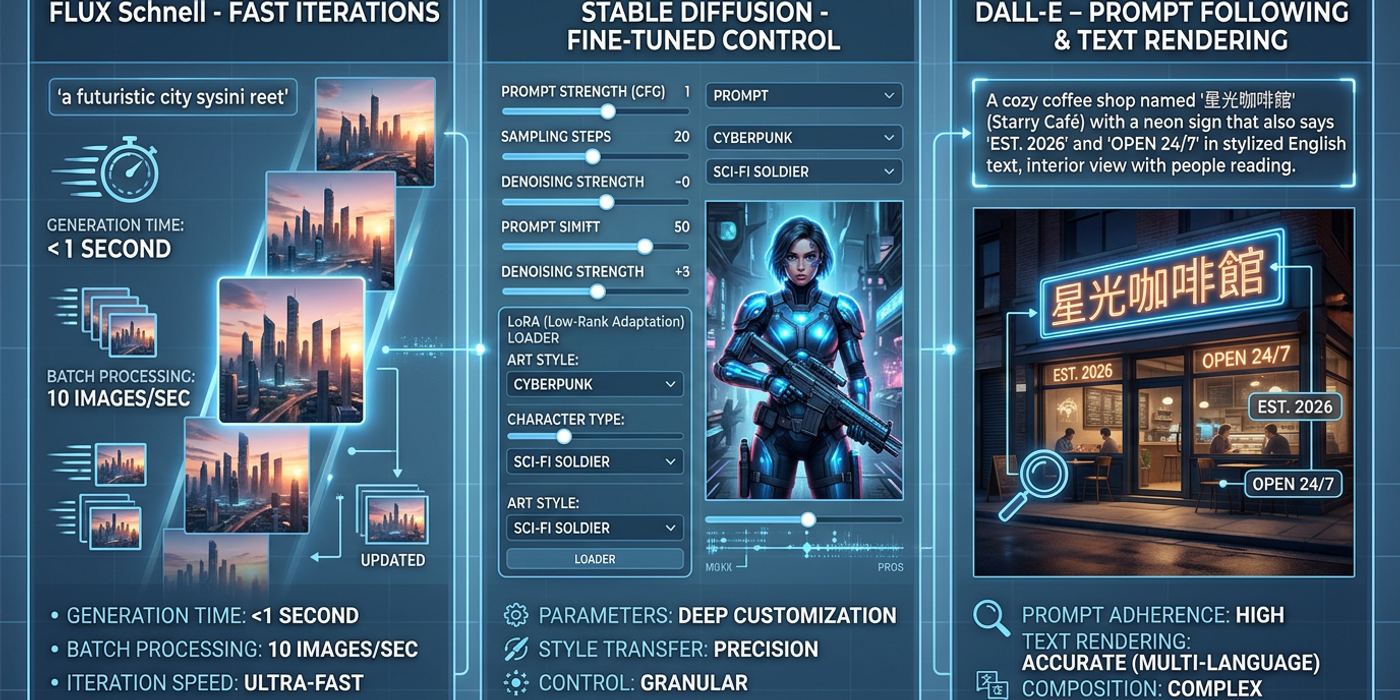
Rapid prototyping and bulk generation. Need 50 variations of a product shot, 30 concept thumbnails for a client pitch, or a batch of social media assets in minutes? FLUX Schnell delivers. A single generation completes in under two seconds on a decent GPU, and the model runs locally with open weights — no API calls, no rate limits, no per-image cost. For Hong Kong agencies producing high volumes of client revisions, that speed translates directly into faster turnaround.
Self-hosting for unlimited use. FLUX Schnell is fully open-weight, so you can run it on your own hardware or a cloud GPU. The cost per image drops to effectively zero once you've covered compute. Teams producing hundreds of images daily benefit enormously.
Community fine-tunes for specific styles. The open ecosystem means you can download fine-tuned versions trained on specific art styles, product photography aesthetics, or brand looks. Instead of engineering prompts to approximate a style, load a LoRA and get consistent results instantly.
The trade-off is prompt adherence. FLUX Schnell can be unpredictable with complex multi-element prompts, and text rendering remains inconsistent. For jobs where precision matters more than speed, look at the other two.
When Stable Diffusion Wins: Control and Customisation
Stable Diffusion remains the king of fine-grained control. If your workflow demands repeatable precision, this is your model.
Custom LoRAs and fine-tuned outputs. The Stable Diffusion ecosystem supports thousands of community LoRAs and Checkpoints for everything from architectural styles to specific character designs. Need a model that understands your brand's exact visual language? Train a small LoRA on your reference images. No other model offers this depth of customisation without enterprise pricing.
ComfyUI for complex multi-stage pipelines. When your workflow involves upscaling, inpainting, ControlNet pose guidance, and final polish, ComfyUI with a Stable Diffusion backend gives you visual node-based control over every stage. For production teams generating consistent e-commerce catalogues or multi-variant ad creative, this pipeline automation saves hours per project.
Consistency across brand assets. Need the same product across 20 different backgrounds with matching lighting and perspective? Stable Diffusion with IP-Adapter or ControlNet delivers. The multi-model ecosystem lets you chain tools to achieve what no single black-box API can.
The price is setup effort. Stable Diffusion requires local or cloud GPU infrastructure, and initial pipeline configuration takes time. For one-off quick jobs, it's slower than the alternatives.
When DALL-E Wins: Prompt Adherence and Reliability
DALL-E, integrated into ChatGPT and available via OpenAI's API, is the model you reach for when precision matters above all else.
Superior prompt adherence. DALL-E consistently follows complex multi-part prompts better than any open-weight alternative. If your prompt specifies "a red ceramic teapot on a wooden table with morning light from the left, steam rising in a spiral," DALL-E delivers something very close. For client-facing work where output must match the brief, this reliability saves iteration cycles.
High-quality text rendering. Need images with legible Chinese or English text — signage, product labels, social media graphics? DALL-E handles text rendering better than any image model available in late 2026. For Hong Kong brands producing bilingual marketing materials, this alone can justify the choice.
Zero configuration, integrated into your existing tools. DALL-E works inside ChatGPT, so you can refine prompts conversationally and see results immediately. The API integrates with any modern tech stack. No GPU setup, no model downloads, no ComfyUI configuration. For teams that prioritise "just works" over customisation, DALL-E removes all infrastructure friction.
Predictable but higher per-image cost. Unlike self-hosted models, every DALL-E generation costs a fixed API fee. For low-volume, high-quality work this is fine. For bulk generation it adds up fast.
Practical Decision Framework
- Need images fast, in high volume, or on a tight budget? → FLUX Schnell. Bulk generation, rapid prototyping, open-weight self-hosting. - Need precise control, consistent branding, or custom styles? → Stable Diffusion. LoRAs, ControlNet, ComfyUI pipelines. - Need reliable prompt adherence or legible text? → DALL-E. Complex prompts, text rendering, zero-setup reliability.
In practice, many Hong Kong creative teams use all three in rotation. DALL-E for the initial client brief visual (where prompt adherence matters), FLUX Schnell for batch variations and social media assets, and Stable Diffusion with ComfyUI for final production assets that need precise brand consistency.
The models aren't competing against each other. They're complementary tools in a well-stocked creative toolkit, and knowing which one to reach for separates an efficient workflow from one that burns time and budget on the wrong model.
Frequently Asked Questions
Q: Which model generates the highest quality images? A: It depends on your definition. DALL-E leads in prompt adherence and text rendering. FLUX Schnell leads in speed-per-quality ratio. Stable Diffusion leads in fine-tuned control. Each wins on a different dimension.
Q: Can I use all three models in one workflow? A: Yes, and many Hong Kong agencies do. Use DALL-E for the first client draft, FLUX Schnell for bulk iterations, and Stable Diffusion with ComfyUI for final production. Each complements the others.
Q: Is FLUX Schnell still the fastest image model? A: In its speed tier, yes — under two seconds on decent hardware. Newer entrants like Nano Banana 2 are competitive on quality, but FLUX Schnell remains the fastest for high-volume production.
Q: How much does it cost to self-host Stable Diffusion or FLUX Schnell? A: A single RTX 4090 can run both. At Hong Kong cloud GPU rates, expect roughly HK$8–15 per hour. For teams generating 500+ images monthly, self-hosting becomes cheaper than any API.
Q: Does DALL-E support Chinese text in images? A: Yes, though English text is more reliable. For bilingual content, generate the base image first, then overlay text in a design tool. DALL-E handles Chinese signage well with clear prompts specifying the exact characters.
Q: Are these three still the industry standard in late 2026? A: They remain the most widely used, but the landscape has grown. Nano Banana 2, Ideogram 4.5, and GPT-Image-2 have entered the conversation. Most professionals still rely on one of these three as their primary model, with newer models serving specialised roles.
Q: Which model is best for a beginner? A: DALL-E inside ChatGPT offers the gentlest learning curve. No setup, no GPU, no technical configuration. FLUX Schnell is a close second if you're comfortable installing a local app.
Q: Can Stable Diffusion match DALL-E's prompt adherence with enough tuning? A: Close, but not exactly. With ComfyUI, ControlNet, and detailed negative prompts you can approach DALL-E's reliability, but the setup time is significant. For one-off precision work, DALL-E is simpler.