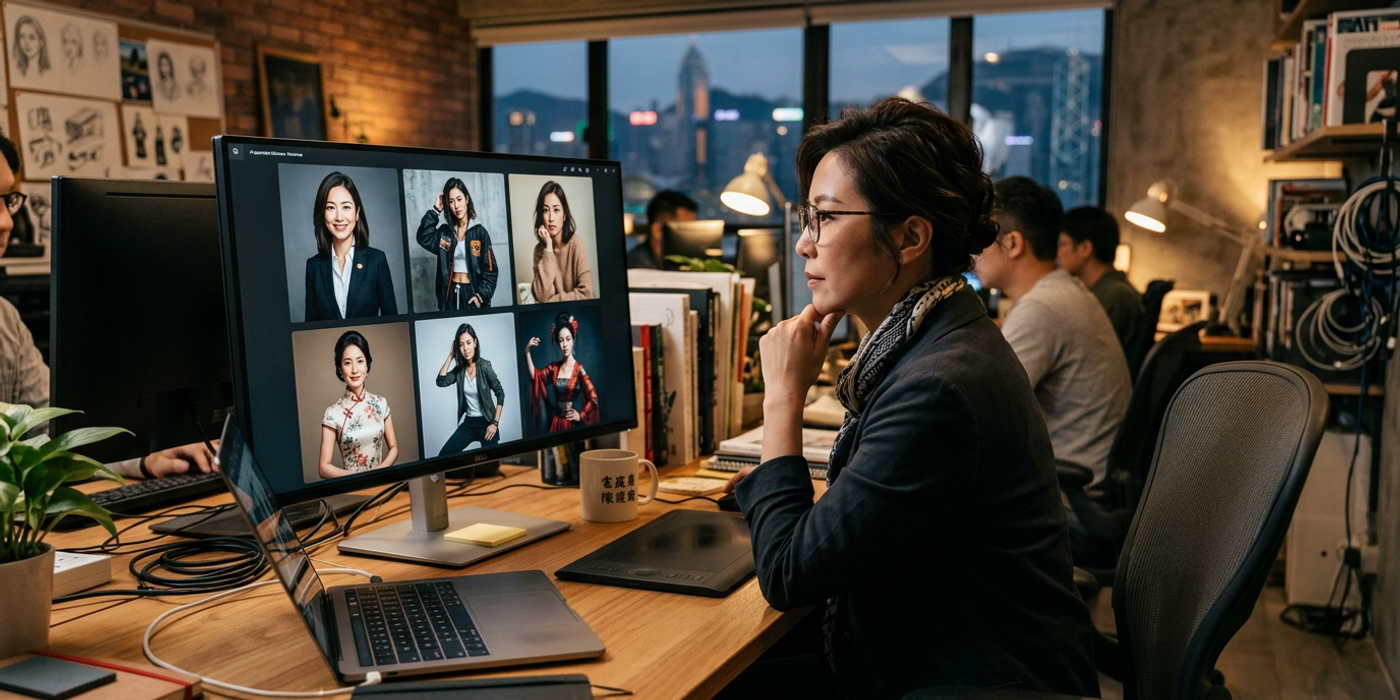
Generate consistent characters across AI models with reference images, IP-Adapter, face swap, and prompt techniques for HK creators in 2026.
Character consistency — getting the same person to look recognisably like the same person across multiple AI-generated images — has long been the biggest quality gap between AI and traditional photography. In 2026, that gap has narrowed dramatically. Hong Kong creators can now produce 20+ consistent character variations in under an hour using reference-based generation, IP-Adapter workflows, and face swap tools. Here's how these techniques work in practice.
Why Character Consistency Matters for Hong Kong Brands
For any brand campaign, character consistency is non-negotiable. A mascot, spokesperson, or product model that shifts appearance between every image undermines brand trust before a viewer reads a single word. Hong Kong agencies running multi-asset campaigns for retail, F&B, and tourism clients face this challenge daily — a character generated for a social media tile rarely matches the same character in a banner ad, website hero, or OOH placement.
In 2026, the tools for solving this have matured significantly. Models like Seedream 4.5 and Nano Banana 2 now support native character reference modes. Dedicated workflows like IP-Adapter and face swap integrations close the remaining gaps. The result: what used to require manual Photoshop retouching or expensive reshoots can now be handled in a single generation pipeline. For a Hong Kong brand producing a 10-image product campaign, that translates to hours of saved retouching time.
Reference-Based Generation — The Core Approach
The most reliable method for character consistency is reference-based generation. You provide the AI with one or more images of your character and ask it to generate new outputs preserving the same face, outfit, and overall appearance.
Seedream 4.5 Character Reference Mode. StepFun's latest model includes a dedicated character reference toggle. Upload one high-quality reference photo — ideally a front-facing shot with even lighting — and the model extracts facial features, hair style, and clothing details. New generations retain these traits across different poses, backgrounds, and lighting conditions. Best results come from images where the character is the main subject with minimal background noise.
Nano Banana 2 Consistent Character Pipeline. Nano Banana 2 takes a broader approach. Instead of extracting just the face, it builds a multi-dimensional character profile including body proportions, clothing style, and colour palette. This makes it particularly useful for full-body character shots and product demonstrations where clothing consistency matters as much as facial features. For HK e-commerce brands showing a model wearing different outfits, this is the more practical choice.
IP-Adapter and Face Swap — When Native Support Isn't Enough
Not all AI image models offer native character consistency. That's where supplementary tooling comes in.
IP-Adapter is a lightweight adapter for Stable Diffusion–based models. It injects image features — like a character's face or style — directly into the generation process without requiring LoRA training or fine-tuning. The workflow: generate your base scene with a prompt, apply IP-Adapter with your reference character image, and the output preserves facial structure while adapting to the new pose and setting. It works best with Flux Schnell and SDXL models available through ComfyUI. The setup takes about 10 minutes and runs locally with zero API costs.
Face swap integrations offer a simpler but more constrained approach. Tools like InsightFace and ReActor swap a target face onto a generated body. The advantage is near-perfect facial similarity. The trade-off: the rest of the character — clothing, hair, body type — may drift between generations, giving inconsistent full-body results. For HK ad campaigns where only the face needs to match, such as placing an actor's face on multiple outfit variants in a catalogue, face swap is often faster than full reference-based generation.
Prompt Engineering for Consistency — Still Essential
Even with advanced reference tools, prompt engineering remains critical. A well-structured prompt tells the model which character traits to preserve and which to vary.
The identify-preserve-vary framework. Start by identifying the character's fixed attributes — face structure, hair colour, build. Preserve them explicitly in your prompt. Then call out which elements should vary: pose, background, expression. Example: "A young woman with shoulder-length black hair and a red blazer, smiling warmly, standing in a modern Hong Kong café, soft natural lighting" — the face and outfit are preserved while the pose and setting change freely.
Negative prompts for drift prevention. When character appearance drifts between generations, your negative prompt is the fix. Add terms like "different face," "different hairstyle," "different clothing" as negative prompts to tell the model what not to change. Models like Flux Schnell and Seedream 4.5 respond well to negative prompting for character preservation, making this a reliable fallback when reference modes produce inconsistent results.
Frequently Asked Questions
Q: Which AI model is best for character consistency in 2026? A: Seedream 4.5 offers the most reliable native character reference mode, followed by Nano Banana 2 for full-body consistency. For maximum control, pair IP-Adapter with Flux Schnell.
Q: How many reference images do I need? A: One high-quality front-facing shot is sufficient for most models. Adding a side profile and back view improves accuracy for 360-degree character generation.
Q: Does character consistency work across both image and video AI? A: Increasingly yes. Veo 3.1 and Kling 3.0 can accept reference character images for consistent video generation, though the feature is less mature than image-based tools.
Q: How do I avoid the "same face" problem when generating multiple characters? A: Use separate reference images for each character and run them through distinct passes. Combining multiple characters in one prompt without references often produces lookalike faces.
Q: Can I use character consistency for Cantonese-language Hong Kong campaigns? A: Yes. Reference-based generation is language-agnostic. It works on faces and clothing regardless of cultural context. For voiceover consistency, pair with AI voice tools.
Q: What's the most cost-effective way to maintain character consistency? A: Use IP-Adapter with open-source models through ComfyUI — it's free and runs locally. For production speed, Seedream 4.5's API is cost-effective at scale.
Q: How long does it take to set up a consistent character workflow? A: Initial setup takes 15-30 minutes. Once your reference images and prompts are saved, generating consistent variations takes about 2-3 minutes per image.