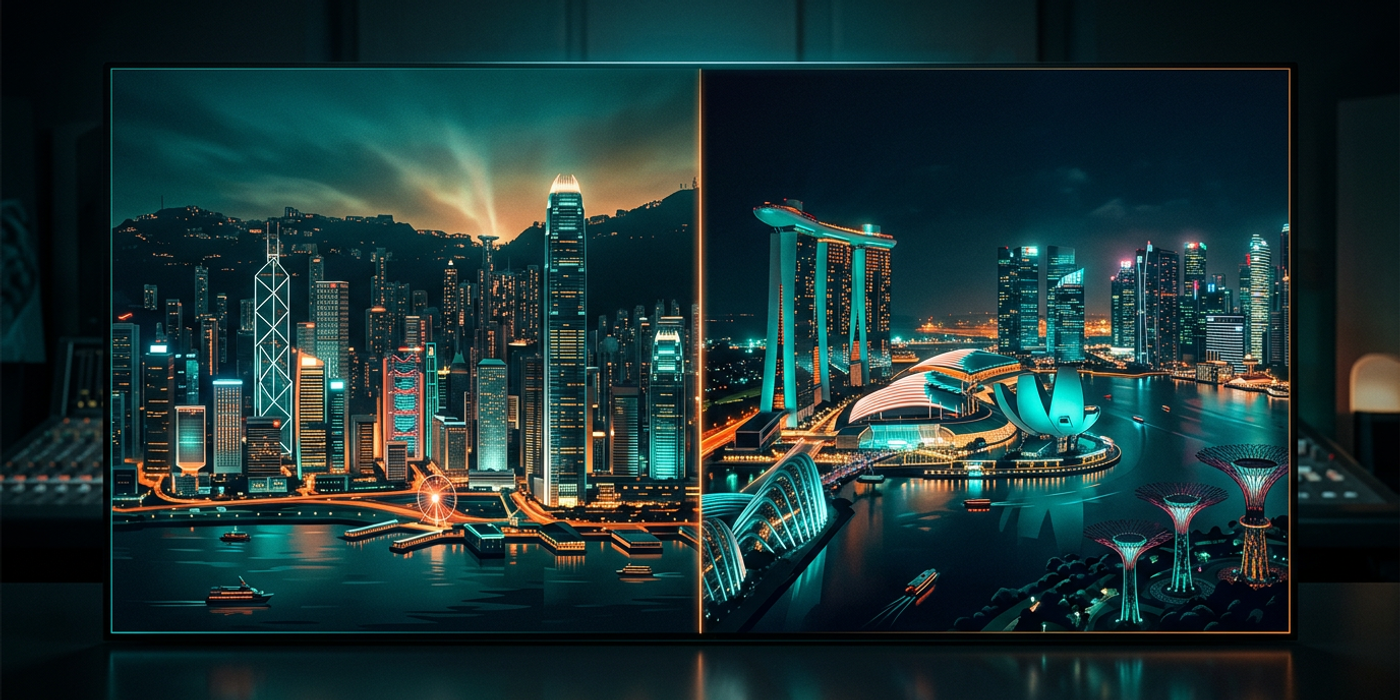
Hong Kong and Singapore diverged in AI creative production. HK leads with Chinese video model pipelines; Singapore excels at brand workflow automation.
Where Each Market Specialised
By late 2026, Hong Kong's AI creative scene has gravitated toward film-adjacent production. Access to Wan3.0 for 30-second video, Seedance 2.5 for one-pass video-plus-audio, and MiniMax H3 for native stereo video has made HK a testing ground for Chinese model pipelines. Agencies here run high-volume social media content, real estate virtual tours, and advertising adaptations — often producing three to five variations of the same creative in Cantonese, Mandarin, and English.
Singapore's AI creative sector has built strength around structured brand content. Western model access — Veo 3.1, FLUX 3, Ideogram 4.5, ElevenLabs Eleven v4 — shaped an ecosystem focused on corporate storytelling, product launches, and multilingual campaigns serving the Southeast Asian region. Singapore agencies invest more in workflow automation and brand consistency tooling; the production pipeline itself is a product.
Neither path is better. They serve different client bases.
Model Access — Who Gets What First
Hong Kong's proximity to mainland AI companies gives it an edge on Chinese model access. When Alibaba launched Wan3.0, Hong Kong creators were among the first to build production pipelines around it. Same with Seedance 2.5, Qwen-Image-2.1, and MiniMax-Music3. These models tend to be cheaper per generation and optimised for Asian-language prompts and visual styles.
Singapore typically gets Western models at the same time as other English-speaking markets. Veo 3.1's GA launch, FLUX 3 Video, Ideogram 4.5's in-place editing, and ElevenLabs Eleven v4 all reached Singapore creators on day one. The trade-off is higher per-generation costs but access to features that Chinese models sometimes lack — detailed prompt adherence, structured output, and advanced editing controls.
In practice, both markets now run multi-model pipelines. A Hong Kong creator might use Wan3.0 for initial video drafts and Veo 3.1 for the final render. A Singapore creator might use FLUX 3 for concept art and Qwen-Image-2.1 for cost-efficient bulk generation. The wall between Chinese and Western models has become porous.
Cost Landscape in Late 2026
Pricing convergence has been the biggest story of the second half of 2026. Chinese model APIs have come down further — Qwen-Image-2.1 runs on consumer GPUs, Wan3.0 pricing dropped twice since launch, and MiniMax H3 undercuts most Western video models by 40% to 60%.
Western model pricing has stabilised rather than fallen. Veo 3.1, FLUX 3, and Ideogram 4.5 maintain premium tiers with advanced features that Chinese models do not yet match — multi-shot video, in-place image editing, and structured prompt control. The cost gap has narrowed but not closed.
For Hong Kong creators, the cheapest production path for high-volume social media content runs through Chinese model APIs. For Singapore creators targeting corporate clients with brand-consistency requirements, Western model pricing is easier to justify when the deliverable demands precise output control.
Talent and Tooling
Hong Kong's talent advantage lies in bilingual prompt engineering. Creators who write fluently in both Chinese and English produce better results from models that respond natively to Asian visual references. The city's film and advertising heritage means AI video tooling is often customised for narrative workflows — script-to-storyboard-to-video pipelines common in local agencies.
Singapore's strength is in production system design. Agencies have invested in automation layers, quality assurance workflows, and brand guideline enforcement tooling. The output may not be as visually adventurous, but it scales reliably. A Singapore agency can produce 20 brand-compliant social media variations in a day with minimal manual intervention.
Which Market Wins for What
Hong Kong wins for high-volume content, Asian-language-first production, experimental video, and real-time social media creative. The pipeline speed and model diversity are unmatched.
Singapore wins for corporate brand content, multi-market regional campaigns, workflow consistency, and client-facing production dashboards. The reliability and repeatability are stronger.
Most serious creators in both markets are building hybrid workflows — picking the best model for each job rather than committing to one ecosystem.
Frequently Asked Questions
Q: Is it cheaper to produce AI content in Hong Kong or Singapore? A: Hong Kong has lower per-generation costs thanks to cheaper Chinese API pricing. Singapore's total production cost can be higher, but the output often requires less rework.
Q: Which market has better access to AI video models? A: Hong Kong gets Chinese video models first — Wan3.0, Seedance 2.5, MiniMax H3. Singapore gets Western video models first — Veo 3.1, FLUX 3 Video. Both can access most major models through APIs.
Q: Do Hong Kong creators use Western models at all? A: Yes — multi-model pipelines are standard. A typical HK production might use Wan3.0 for drafts and Veo 3.1 for final renders.
Q: Can Singapore creators access Chinese AI models? A: Yes, through cloud API access. Latency is slightly higher than Hong Kong, and some documentation is Chinese-first, but the models are accessible.
Q: Which market has better AI talent? A: Both have strong but different talent pools. Hong Kong leads in bilingual prompt engineering and video production. Singapore leads in production system design and workflow automation.
Q: How has pricing changed since mid-2026? A: Chinese model API pricing dropped 40% to 60% since mid-2026. Western model pricing stabilised. The gap has narrowed but Chinese models remain significantly cheaper per generation.
Q: What is the biggest mistake creators make when comparing the two markets? A: Treating them as interchangeable. Each market's AI ecosystem has developed to serve different client bases — ignoring that context leads to wrong tool choices.
Q: Will the two markets converge in 2027? A: Partially. Model access will keep narrowing, but the use-case specialisation — HK for video volume, Singapore for brand consistency — is likely to persist.