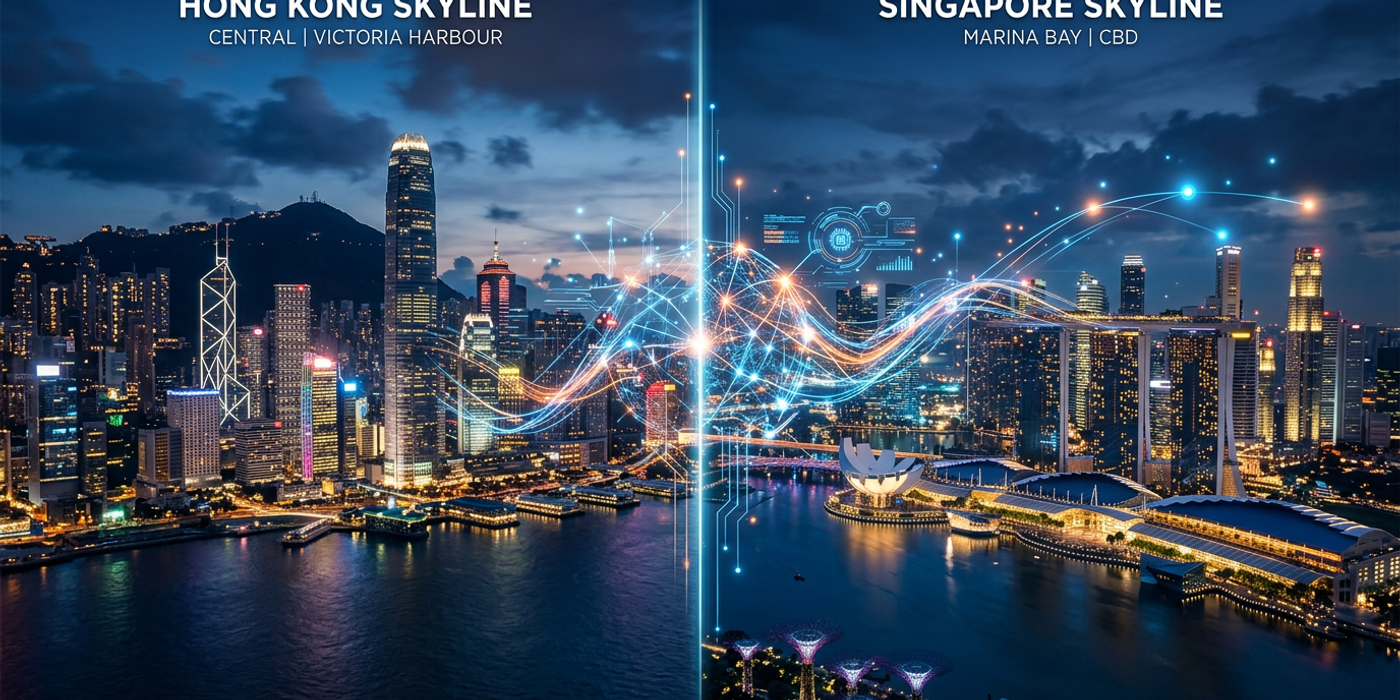
Compare Hong Kong vs Singapore on AI creative tool adoption in 2026 — government support, creator habits, costs, and which AI models each market loves most.
Hong Kong and Singapore have long been rivals — financial hubs, regional gateways, both punching above their weight. But in 2026, a new battleground has emerged: AI creative tool adoption.
Both markets are racing to integrate generative AI into advertising, film production, e-commerce, and content creation. But which one is moving faster? And what can creators in each market learn from the other?
Let's break it down.
Government Support: Who's Backing AI Creators?
Singapore has been aggressive. The National AI Strategy 2.0, launched in 2024, funnelled significant funding into AI adoption across industries — including media and creative sectors. The Infocomm Media Development Authority (IMDA) runs grants specifically for small and medium creative agencies to adopt AI production tools. By 2026, Singapore has a structured, top-down approach: subsidies for AI tool licenses, training programmes for creatives, and tax breaks for agencies that invest in AI workflows.
Hong Kong has been catching up fast. The 2025-26 Budget allocated HK$1 billion to AI development, with a portion directed toward creative industries. Cyberport's AI Supercomputing Centre, operational since late 2025, provides local creators with subsidised compute for AI rendering and model fine-tuning — a game-changer for video production studios working with long-form AI content. But the support is less centralised than Singapore's. Hong Kong's strength is its bottom-up adoption: agencies and freelancers are investing in AI tools on their own, driven by competitive pressure rather than government incentive.
Edge: Singapore for structured support. Hong Kong for organic, market-driven adoption.
Tool Adoption: What Creators Are Using
In Singapore, the most popular AI creative tools in 2026 skew toward all-in-one platforms. Runway's Gen-3 and Gen-4 have strong adoption among Singaporean advertising agencies for short-form campaign content. Kling 2.0 and Kling 3.0 are also widely used for Southeast Asian market content — especially for Malay and Tamil language localisation. Singaporean creators tend to adopt tools that offer API access first, prioritising scalable production pipelines.
In Hong Kong, the landscape is more diverse. Veo 3.1 and Luma Ray3.x lead in video generation, driven by Hong Kong's film and TV production heritage — creators want cinematic quality, not just volume. Nano Banana 2 and Seedream 4 dominate image generation for product photography and e-commerce catalogs, reflecting Hong Kong's strong retail sector. Cantonese-language TTS tools see heavy use for localised content, a niche that Singapore's English-first market doesn't prioritise as much.
Edge: Hong Kong for production quality. Singapore for scalable, API-first workflows.
Talent Pipeline and Skills
Singapore has invested heavily in AI education through SkillsFuture credits and university partnerships. By 2026, a significant portion of graduating media students have AI prompt engineering and AI video production modules in their portfolios. The talent pool is young, trained specifically in AI-first workflows, but lacks deep traditional production experience.
Hong Kong benefits from a mature creative industry with decades of film, TV, and advertising expertise. Veterans who started with traditional cameras and editing suites are now upskilling into AI tools — often through private workshops and self-study rather than formal programmes. The result is a hybrid skillset: creators who understand lighting, composition, and narrative structure AND how to achieve it with AI tools. This is especially visible in Hong Kong's advertising agencies like Havas, BBDO, and Ogilvy, where senior creatives are leading AI integration.
Edge: Singapore for volume of AI-native talent. Hong Kong for depth of hybrid skills.
Cost of Production: Who Gets More for Less?
Singapore's subsidised AI tool programmes and lower studio rental costs (compared to Central and Causeway Bay) give it an edge in baseline production economics. A Singaporean agency producing a 30-second AI-generated TVC spends roughly 15-20% less than a Hong Kong agency doing the same work — largely due to rent and labour cost differences.
But Hong Kong agencies are closing the gap through efficiency. The same agency that pays more per hour also produces faster — Hong Kong's 24-hour turnaround culture and dense agency network means faster revision cycles and tighter client feedback loops. AI tools amplify this speed advantage: a Hong Kong team can ideate, generate, and deliver a campaign in 48 hours, a speed that Singaporean agencies still struggle to match.
Edge: Singapore for baseline cost. Hong Kong for speed and turnaround.
Which Market Will Win the AI Creative Race?
The honest answer is: they don't need to race each other.
Singapore's structured, government-backed approach is building a scalable, API-driven creative economy that's ideal for regional content production and multilingual Southeast Asian campaigns. Hong Kong's organic, quality-first approach is producing some of the most visually sophisticated AI-generated content in Asia — work that holds up alongside top-tier global advertising markets like London and Tokyo.
For creators, the smartest move is to borrow from both models: use Singapore's subsidised infrastructure for high-volume production and Hong Kong's production expertise for high-quality creative work. Cooly Studio supports creators in both markets with access to leading AI models — Veo 3.1, Nano Banana 2, Seedream 4, Kling 3.0, and more — all in one platform, so you can choose the right tool for the job regardless of which side of the strait you're on.
Frequently Asked Questions
Q: Which market has more AI creative tools available? A: Both have access to essentially the same global tools (Runway, Kling, Veo, Luma, Midjourney, etc.). The difference is which tools each market prioritises: Singapore leans toward API-first platforms, while Hong Kong favours cinematic-quality models.
Q: Is government support necessary for AI adoption in creative industries? A: Not strictly — Hong Kong's organic adoption shows that market pressure and competitive necessity drive adoption just as effectively. But government subsidies do lower the barrier to entry for smaller agencies.
Q: Which market is better for launching an AI-focused creative agency? A: Singapore offers lower operating costs and government grants. Hong Kong offers a higher concentration of premium clients and a faster production culture. Choose based on your target client base.
Q: Do Hong Kong and Singapore creators use different AI models? A: Yes, notably. Hong Kong leans heavily on Veo 3.1 and Luma for video and Nano Banana 2 / Seedream 4 for images. Singapore favours Kling and Runway for video and Stable Diffusion / Flux for images.
Q: Which market has better Cantonese-language AI support? A: Hong Kong, by a wide margin. Cantonese TTS, voice cloning, and content localisation tools are much more developed for Hong Kong's market than Singapore's English-first ecosystem.
Q: Is the cost of AI tool subscriptions different between the two markets? A: No — most AI tools charge the same global pricing. The cost difference comes from labour, studio space, and whether government subsidies are available.
Q: Which market is adopting AI creative tools faster in 2026? A: By pure adoption metrics, Singapore is moving faster due to government incentives and structured training. But Hong Kong is producing higher-quality AI creative work per capita, thanks to its deep pool of experienced production talent.
Q: Do I need to choose between Hong Kong or Singapore for my AI creative work? A: Not at all. Cooly Studio works in both markets — you can access all the same AI video and image generation tools anywhere. The best approach is to combine Hong Kong's creative firepower with Singapore's production efficiency.