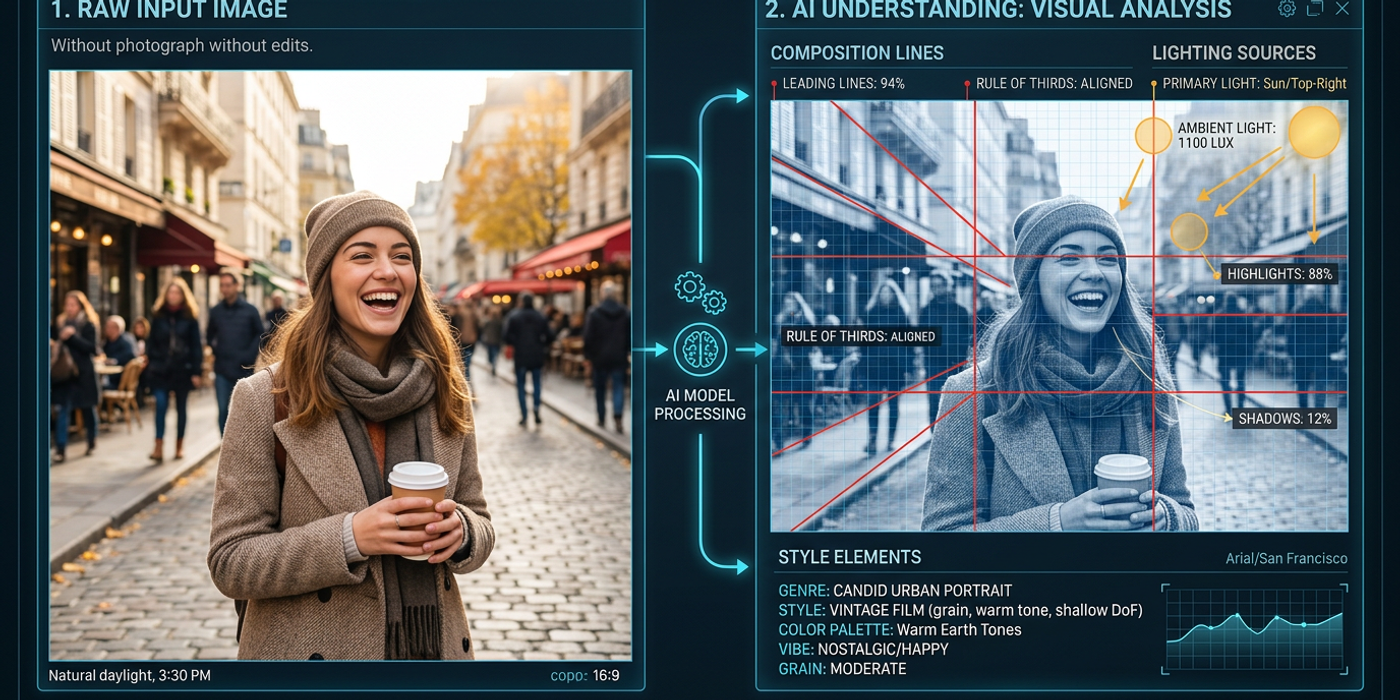
Modern AI like Seedream 4 and Nano Banana 2 understand composition, lighting and style better than ever. Learn how to get better results.
Have you ever wondered how AI image models seem to "understand" what makes a good photograph? They don't just copy pixels — they learn the same visual principles that human photographers and designers spend years mastering. Composition, lighting, and style are the three pillars of visual quality, and in 2026, AI models handle them more intelligently than ever.
Whether you're using Seedream 4 for product shots, Nano Banana 2 for creative concepts, or Meta Muse Image for social media content, understanding how these models "see" your prompts will help you generate images that look intentional, polished, and professional.
How AI Models Understand Visual Composition
Composition is the arrangement of elements within a frame. In 2026, AI image models have trained on millions of professionally composed photographs, films, and artworks. This training gives them an intuitive grasp of compositional rules.
The rule of thirds — AI models naturally gravitate toward placing subjects off-centre. When you prompt "a person standing by a window, looking out," the model typically positions the person on the left or right third of the frame, leaving the window view on the opposite side.
Leading lines and depth — Models like Seedream 4 and Nano Banana 2 excel at creating depth through leading lines. A prompt like "a road disappearing into a misty forest" generates strong perspective lines that draw the eye into the distance, because the model understands converging lines instinctively.
Negative space — Hong Kong creative agencies have discovered that AI models handle negative space surprisingly well. When you prompt "minimalist product shot, white background, single object on the left," the model respects the empty space and uses it to balance the composition. This makes AI-generated product photography for e-commerce much more usable out of the box.
Framing and foreground elements — Advanced models now incorporate framing elements like tree branches or doorways without being explicitly told. This creates images that feel more natural and layered.
How AI Models Handle Lighting
Lighting makes or breaks a photograph. In 2026, AI image models distinguish between dozens of lighting conditions and apply them with remarkable consistency.
Light source awareness — When you prompt "golden hour portrait, warm backlight," the model understands where the light source is positioned, how it affects the subject's edges (rim lighting), and how it warms the overall colour palette. It simulates the physics of light, not just a filter.
Three-point lighting — Professional portrait lighting setups are now reliably generated. "Studio portrait, soft key light from the right, fill light on the left, rim light from behind" produces images that look like they were shot in an actual studio.
Mood and atmosphere — Models understand the emotional impact of lighting. "Moody, low-key lighting, dramatic shadows, rain-slicked streets at night" produces images with high contrast, deep shadows, and cool colour tones. "Bright, airy, soft natural light, pastel colours" produces an entirely different emotional register.
Global illumination — Mid-2026 models like Nano Banana 2 and Muse Image have improved dramatically at rendering complex lighting. A prompt like "sunlight streaming through stained glass" now generates realistic caustics, coloured light patterns, and proper shadow falloff — rare in AI images just a year ago.
How AI Models Interpret Style
Style is the most subjective of the three pillars, and it's where 2026 models have made the biggest leaps.
Training on art history — AI models have ingested everything from Renaissance oil paintings to contemporary digital art. When you prompt "watercolour illustration, soft edges, paper texture visible," the model draws on its knowledge of watercolour techniques — pigment pooling, colour bleeding — to create an authentic effect rather than a filter overlay.
Style separation from content — A key advance in 2026 is the ability to separate style from content. You can prompt "a photo-realistic portrait in the style of anime" and get a hybrid that preserves photographic skin texture and lighting while incorporating anime's clean linework and colour palette. Models now understand style as a separate dimension of generation.
Art movements and aesthetics — Characterising a style by its art movement works remarkably well. "Art Deco poster, 1920s geometric patterns, gold accents, luxury aesthetic" reliably generates images with symmetrical compositions, bold geometric frames, and specific Art Deco colour palettes. Similarly, "Cyberpunk, neon blue and magenta, 2049 aesthetic" triggers a consistent visual vocabulary.
Brand style consistency — For Hong Kong agencies working with brands, this is where 2026 models shine. When you use reference-image tools like IP-Adapter, the model extracts your brand's visual DNA — colour palette, texture treatment, contrast ratio — and applies it as a coherent style framework.
Putting It All Together
The best AI images in 2026 combine all three pillars intentionally. For example, a product shot for a premium Hong Kong watch brand might combine off-centre framing with negative space, a single strong key light from above-left for dramatic depth, and a clean editorial photography aesthetic inspired by high-end catalogues.
Understanding how AI models think about these elements means you can prompt more effectively, iterate faster, and get closer to your creative vision in fewer generations. The models are already sophisticated — the question is how well you speak their language.
Frequently Asked Questions
Q: Do AI image models actually "see" images the way humans do? A: No — they process images as pixel patterns in latent space, but training on human-curated images means they've learned what humans find visually appealing.
Q: Can I control composition more precisely in 2026 models? A: Yes. Models like Seedream 4 and Nano Banana 2 support image-to-image workflows where you provide a rough composition sketch or layout, and the model generates the final image respecting your structure.
Q: Why does my AI image sometimes have inconsistent lighting? A: Complex multi-source lighting prompts can still confuse models. Keep your lighting prompt simple — one primary source and one secondary — and use reference images for complex setups.
Q: Which AI model is best for style control in 2026? A: Meta Muse Image excels at style transfer from references. Seedream 4 offers the most reliable style-from-text. For Hong Kong brands, combining both works best.
Q: Can AI generate images in a specific Hong Kong visual aesthetic? A: Yes. Prompts like "Wong Kar-wai cinematic style, neon lighting, shallow depth of field" generate images that capture Hong Kong's distinctive visual character, thanks to training on films and photography from the region.
Q: How many composition rules does a typical AI model understand? A: Leading lines, rule of thirds, symmetry, framing, negative space, colour harmony and depth layering are all well-handled by 2026 models. Subtle rules like the golden spiral are less consistently applied.
Q: Do I need to mention specific lighting terms in my prompts? A: Not always, but it helps. If you don't specify lighting, the model defaults to "correct" but generic lighting. Adding terms like "golden hour," "soft diffused light," or "dramatic side lighting" shifts the output significantly.
Q: Will future models understand composition and lighting even better? A: Absolutely. The trend is toward models that can follow detailed technical specifications — think "f/2.8 aperture, 85mm lens, shallow depth of field" — and execute them with professional precision.