Understand how today's AI image generators really work under the hood. A practical breakdown of diffusion, transformer, and hybrid models for creators.
How AI Image Models Work in Late 2026: Practical Guide for Creators
Ever wondered why some AI image models produce photorealistic results in seconds while others give you more creative freedom? The difference comes down to how each model actually generates images. In 2026, three main architectures dominate: diffusion, transformer, and hybrid models. Each one works differently under the hood, with different strengths, weaknesses, and use cases.
This guide breaks down how today's top AI image models actually work — not the academic theory, but the practical differences that affect your daily workflow, output quality, and creative control. Whether you are using GPT-Image-2, FLUX Schnell, Ideogram 4.0, or Nano Banana 2, understanding what is happening inside the model helps you get better results faster.
Diffusion Models: The Workhorse Standard
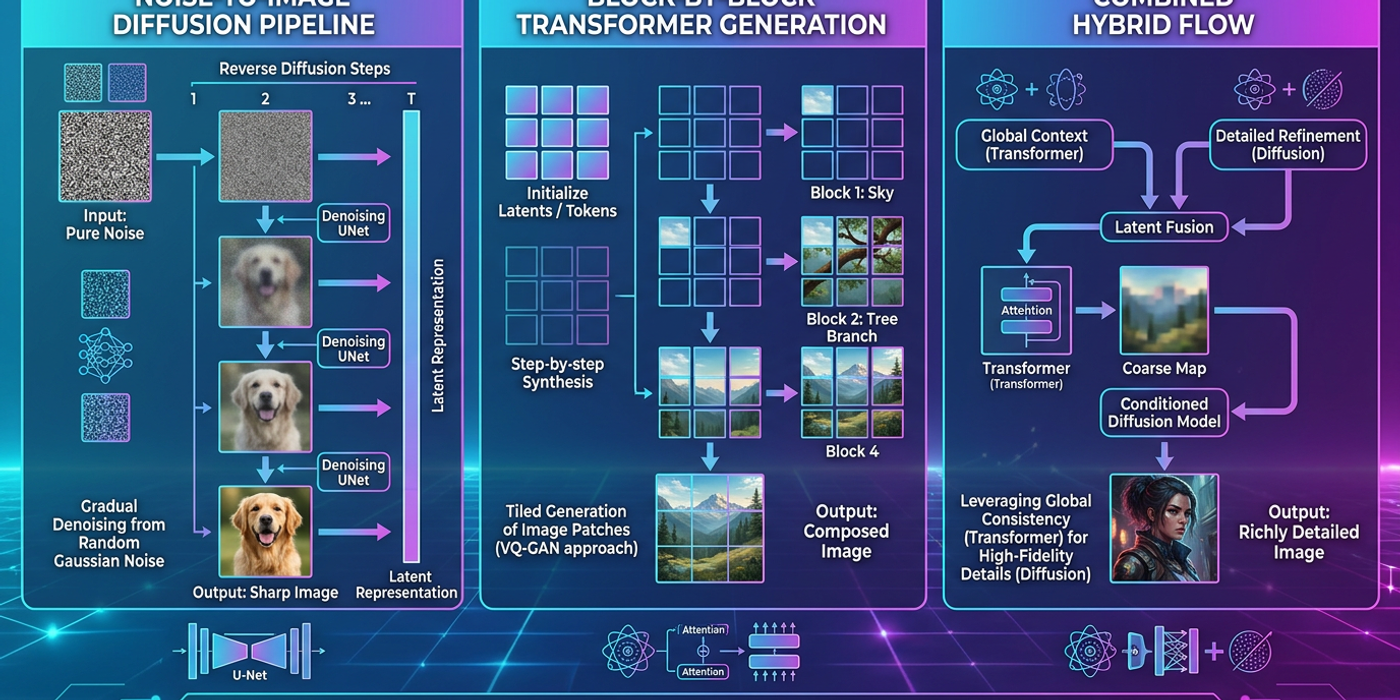
Diffusion models still power most AI image generators in 2026, including FLUX Schnell, Stable Diffusion 4, and Midjourney. Start with pure noise — random pixel data — and gradually remove it until a coherent image emerges. Think of it like a sculptor chiseling away until the statue appears.
The key practical difference for creators: diffusion models excel at detail fidelity. They render textures, lighting, and fine-grained visual elements particularly well. FLUX Schnell produces exceptional image quality because its diffusion process uses an unusually large dataset with complex caption annotations.
However, diffusion models need more inference steps than transformers — typically 20 to 50 per image. Each step refines the image further. This is why speed modes exist: fewer steps means faster generation but potentially lower detail. For quick ideation, 15 steps suffice; for production assets, 30 to 50 steps deliver the best results.
For Hong Kong creators producing commercial work, diffusion models are the safe default for photography, product shots, and detailed illustrations where pixel-level quality matters.
Transformer Models: Speed and Consistency
Transformer-based image generators — Nano Banana 2 and Ideogram 4.0 — treat image generation as a sequence prediction problem, similar to how LLMs predict the next word. The model generates image patches (tokens) one after another, building the picture block by block.
This makes transformers significantly faster. Ideogram 4.0 generates a 2K-resolution image in under 3 seconds on consumer hardware. The speed advantage transforms workflows where iteration time matters — experimenting with compositions or generating variants for client review.
Transformers also produce more compositionally consistent results because the full image layout is determined earlier in the process. The model 'sees' the big picture before filling in fine details, reducing common diffusion problems like doubled anatomy or misaligned elements.
The tradeoff? Transformers sometimes produce slightly less fine-grained texture detail than top-tier diffusion models. For Hong Kong brands that need both speed and quality, many creators now use hybrid pipelines: ideate with a transformer, then finalise with a diffusion model for maximum detail.
Hybrid Models: Best of Both Worlds
The most exciting development in 2026 is the rise of hybrid architectures combining diffusion and transformer approaches. Models like GPT-Image-2 and MAI-Image-2.5 use transformers for initial layout and composition planning, then switch to diffusion-based refinement for fine details.
The practical result: GPT-Image-2 produces images that are both compositionally coherent and richly detailed — competitive with pure diffusion on quality while matching transformers on speed. For Hong Kong creators juggling tight production deadlines, this eliminates the speed-versus-quality tradeoff.
Not all hybrids are equal. GPT-Image-2 excels at photorealism and prompt adherence because its transformer stage understands complex prompt structures. MAI-Image-2.5 favours creative interpretation over strict prompt following, making it better for conceptual and artistic work.
The Generation Pipeline: What Actually Happens
Every AI image model follows the same conceptual pipeline. Knowing it helps you debug poor results and optimise your prompts:
Prompt encoding. Your text prompt is converted into a numerical representation using a language model. Models with better encoders understand complex instructions more reliably. GPT-Image-2 shares its encoder with GPT-4.5, giving it exceptional semantic understanding.
Latent generation. The encoded prompt guides the model as it generates an image in a compressed representation space — not pixel by pixel, but in a lower-dimensional latent space. This is where composition, colour, and subject placement are determined.
Decoding and upscaling. The latent representation is decoded into a full-resolution image and upscaled to your target resolution. Models with dedicated upscalers (like Ideogram 4.0's native 2K output) preserve more detail.
The actionable insight: weak prompts produce weak latent representations. No upscaling or refinement can fix a poorly constructed prompt's latent image. Prompt engineering remains essential even as models get smarter.
How to Choose the Right Model for Your Workflow
Match the model type to your production phase:
- Ideation and iteration: Transformer models (Nano Banana 2, Ideogram 4.0). Fast generation, good composition, quick feedback loops. - Final production assets: Diffusion models (FLUX Schnell, Stable Diffusion 4). Maximum detail fidelity and texture quality. - Balanced speed and quality: Hybrid models (GPT-Image-2, MAI-Image-2.5). Strong across the board with specific strengths depending on the variant. - Batch processing: Diffusion models with fewer steps or transformer models for bulk work where speed outweighs marginal quality gains.
Hong Kong agencies producing hundreds of images weekly often maintain model menus with these assignments. The most efficient teams orchestrate a pipeline where different models serve different stages of production.
Frequently Asked Questions
Q: Do I need to understand the technical differences to get good results? A: Not at all. But knowing the architecture helps you troubleshoot — weak composition suggests a transformer model; flat textures suggest switching to diffusion.
Q: Which architecture produces the most photorealistic images in 2026? A: Diffusion models still lead, particularly FLUX Schnell and Stable Diffusion 4. However, GPT-Image-2 has closed the gap and often surpasses them on complex scene compositions.
Q: Are hybrid models always better? A: Not always. Hybrids excel at balanced output but may not match specialised diffusion models in niche areas like macro photography or medical imaging. Choose the tool for the task.
Q: Why do some models take longer to generate? A: Each inference step costs compute. Diffusion models need 20 to 50 steps. Transformers complete in 3 to 8 steps. Hybrid models sit in between. Fewer steps mean faster results but may sacrifice fine detail.
Q: Does the prompt work the same across model types? A: Generally yes, but transformer models and hybrids with stronger text encoders handle more complex prompts with multiple subjects and spatial relationships. Diffusion models may need simpler phrasing.
Q: What model is best for bilingual content (Chinese + English)? A: Models with multilingual-capable encoders like GPT-Image-2 and Ideogram 4.0 handle Chinese text prompts most reliably. Diffusion models with English-only encoders may misinterpret Chinese descriptors.
Q: Will all models converge to hybrid architectures? A: Likely yes. Open-weight releases expected from Black Forest Labs and Stability AI preview hybrid components. The gap between architectures will continue to narrow.
Q: How does architecture affect cost per generation? A: Transformer models cost less per image because they require fewer compute steps. Hybrid models fall in the middle range. Diffusion models at full step counts are the most expensive. Choose the right architecture for each job.