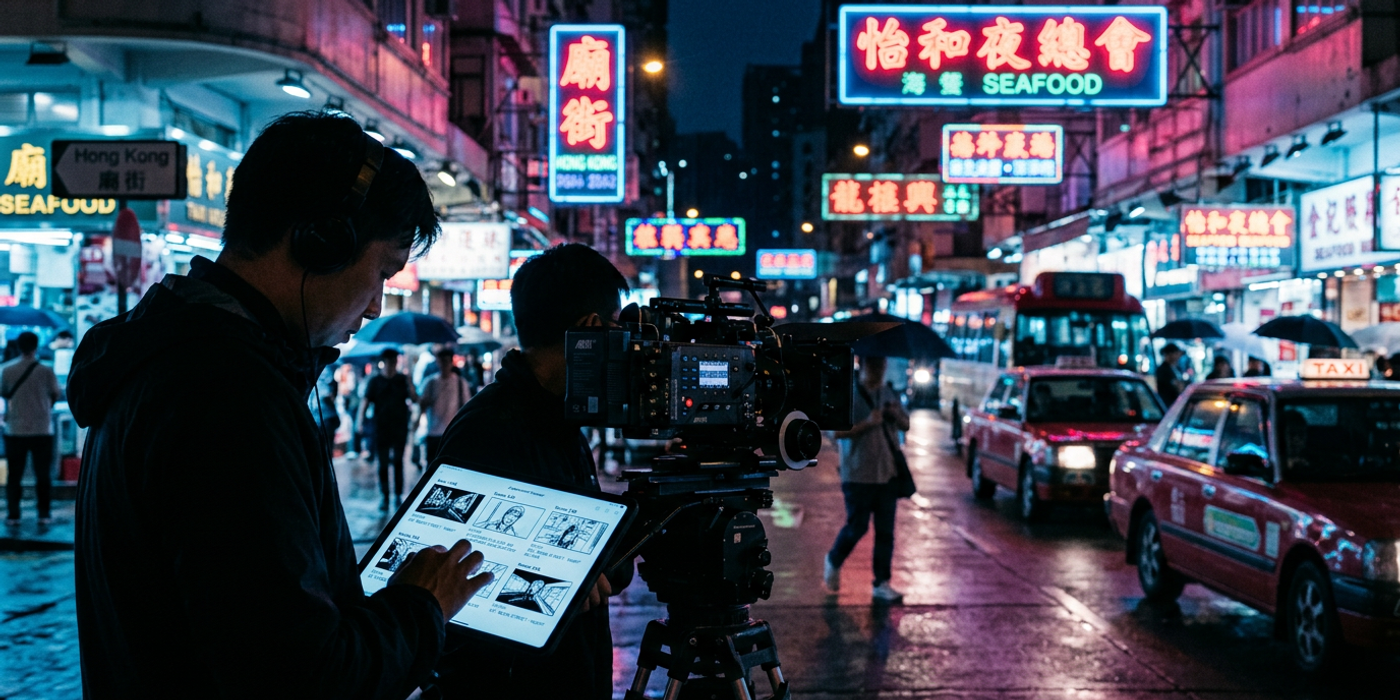
Explore how generative AI is transforming Hong Kong's film production — from pre-visualization and storyboarding to VFX, post-production, and cost savings.
The Hong Kong film industry has always been known for speed, resourcefulness, and creative grit. From the golden age of martial arts cinema to the modern blockbusters shot on Hong Kong's narrow streets, local filmmakers have mastered the art of doing more with less.
But a new tool is reshaping the landscape: generative AI.
AI video generation — powered by models like Veo 3.1, Kling 3.0, and Seedance — is changing how Hong Kong filmmakers approach pre-production, visual effects, and even entire production pipelines. This article explores the real impact on the local industry.
The Pre-Production Revolution
Traditional pre-production in Hong Kong is a race against the clock. Directors and producers often have weeks — not months — to lock down storyboards, shot lists, and visual references before shooting begins.
Generative AI is changing the timeline. Instead of commissioning hand-drawn storyboards at $500–$2,000 per board, production teams can generate concept frames from text prompts in seconds. A director can describe a scene — "night market at 3am, neon reflections on wet asphalt, handheld camera feel" — and get a visual reference instantly.
This isn't just faster. It's cheaper by orders of magnitude.
For independent Hong Kong filmmakers working with tight budgets, AI-generated pre-visualization means they can pitch a clear creative vision without the upfront cost of traditional storyboarding. Production houses working with Cooly Studio can generate, iterate, and export reference frames in a single platform — no need to juggle multiple tools.
AI in Production: From Set to Screen
The line between "production" and "post-production" is blurring. AI video tools now let filmmakers generate supplemental footage, extend backgrounds, and even create entire establishing shots that would otherwise require expensive location shoots.
Hong Kong is famously expensive to film in. A single day on location with permits, equipment, and crew can run $10,000–$30,000 HKD or more. AI-generated establishing shots — a drone flyover of Victoria Harbour, a wide angle of Mong Kok's neon glow, a timelapse of the Star Ferry — can be produced in minutes for a fraction of the cost.
This creates a powerful hybrid workflow: shoot the core performance or action sequence with real actors and practical sets, then augment the environment with AI-generated elements. The result is richer visuals without the budget blowout.
For commercial productions — TV commercials, branded content, music videos — this hybrid model is already becoming standard. Hong Kong advertising agencies are blending real footage with AI-generated transitions, backgrounds, and effects to produce high-impact visuals faster than ever.
Post-Production and VFX
Hong Kong's VFX houses have traditionally relied on expensive render farms and specialized talent. AI video generation introduces a fundamentally different approach.
Instead of spending weeks compositing a CGI background, editors can use AI inpainting and outpainting to expand or modify existing footage. Need to remove a modern building from a period film? AI can handle it. Want to extend a cramped interior into a spacious set? A few prompts can generate the extra space.
AI-powered rotoscoping, color grading, and upscaling tools are also accelerating post-production workflows. Tasks that once required dedicated teams can now be handled by a single editor using the right tools.
For Hong Kong's small-to-medium production houses, this is a game changer. It means they can take on larger projects without expanding their team — and deliver faster turnaround times that match the city's breakneck pace.
The Cost Advantage
Let's talk numbers.
A traditional 60-second TV commercial in Hong Kong with locations, talent, crew, and post-production typically costs $300,000–$800,000 HKD or more. An AI-assisted hybrid production can deliver comparable visual quality for $50,000–$150,000 HKD — a 60–80% reduction.
For independent films, the math is even more dramatic. AI-generated establishing shots, backgrounds, and minor VFX can save $100,000–$500,000 HKD per project, making it viable for emerging directors to produce visually ambitious work on micro-budgets.
And the savings aren't just financial. Production timelines shrink from weeks to days. A music video that would take 10–14 days for pre-production, shooting, and post can be completed in 3–5 days with AI-assisted workflows.
What This Means for Hong Kong Creatives
The shift is not about replacing filmmakers. It's about removing friction.
Hong Kong's film industry has survived economic downturns, shifting audience habits, and rising production costs by adapting. Generative AI is the latest — and perhaps most powerful — adaptation tool yet.
Directors can iterate faster. Producers can say yes to more ambitious ideas. Editors can focus on creative decisions instead of technical drudgery. And new voices who couldn't afford traditional production can now make their films.
The tools are already here. Platforms like Cooly Studio put Veo 3.1, Kling 3.0, Seedance, and dozens of other models behind a single interface — no coding, no GPU setup, no multi-tool chaos. For Hong Kong's next generation of filmmakers, that changes everything.
Frequently Asked Questions
Q: Will AI replace Hong Kong filmmakers? A: No. AI replaces repetitive technical tasks, not creative vision. Directors, cinematographers, editors, and art directors still drive the creative decisions. AI is a tool — like a more powerful editing suite, not a replacement for the editor.
Q: What AI video models work best for Hong Kong film production? A: Veo 3.1 excels at photorealistic cinematic shots and motion coherence. Kling 3.0 handles creative, stylized visuals well. Seedance produces strong results for character animation and creative concepts. The best choice depends on your specific scene requirements.
Q: Can AI-generated footage be used in commercial productions? A: Yes. Most major brands and agencies are already using AI-generated elements in commercials, music videos, and branded content. The key is blending AI output with real footage for a seamless final product.
Q: How much money can AI save on a typical Hong Kong film project? A: Depending on the project size, savings range from 60–80% for commercials and $100,000–$500,000 HKD for independent films. The biggest savings come from pre-production (no storyboard artists) and establishing shots (no location shoots).
Q: Do I need technical skills to use AI video generation? A: Not anymore. Platforms like Cooly Studio provide a visual interface where you type prompts, select models, and generate footage — no coding, GPU setup, or technical expertise required.
Q: Is AI-generated video quality good enough for professional use? A: In 2026, yes. Models like Veo 3.1 and Kling 3.0 produce footage that holds up on large screens. For commercial work, AI-generated elements are typically blended with real footage. For independent films, AI can produce entire sequences at broadcast quality.
Q: How long does it take to learn AI video production? A: Most filmmakers can produce usable results within a few hours of practice. Mastering prompt engineering and workflow integration takes a few weeks. Compared to learning traditional VFX software (months to years), the learning curve is dramatically shorter.
Q: Are there Hong Kong production houses already using AI? A: Yes. Several Hong Kong advertising agencies and boutique production houses have adopted AI video generation for pre-visualization, background generation, and VFX work. The trend is accelerating as more tools become accessible through platforms like Cooly Studio.