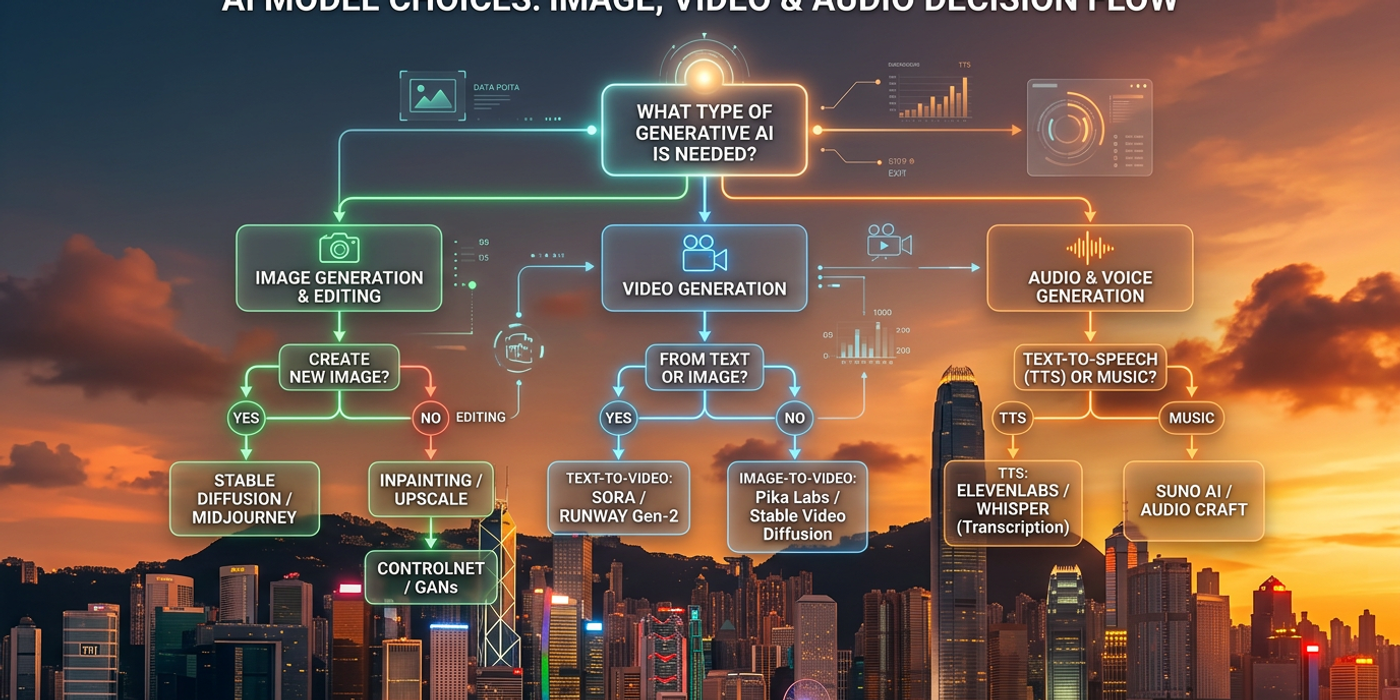
AI models multiply fast in 2026. Here's a practical decision framework for Hong Kong creators — for image, video, and audio projects at every budget level.
Picking the right AI model in 2026 is harder than ever — but also more rewarding. With image, video, and audio models launching almost weekly, Hong Kong creators who choose strategically save time, money, and frustration. Here's a decision framework that works for real projects.
The Mid-2026 AI Model Landscape
The first half of 2026 reshaped the creative AI map. On the image side, Seedream 4 and Nano Banana 2 pushed photorealism to new heights, while Ideogram 4.0 went open-weight with native 2K output. For video, Veo 3.1, Kling 3.0, Seedance 2.5, and FLUX 3 Video each claim different strengths — duration, resolution, native audio. Audio models like Google Lyria 3.5 brought Selective Section Painting, letting creators edit specific parts of a music track without regenerating the whole thing.
This explosion is great for quality but brutal for decision-making. The wrong model choice costs you in generation credits, turnaround time, and output quality.
Step 1: Define Your Output Type
Before comparing models, decide what you're producing. This single choice eliminates most options immediately.
Images: Best for social media content, product photography, ad creatives, and brand assets. Models like Seedream 4, Nano Banana 2, and Flux Schnell cover different quality and speed tiers. If you need photorealism for a luxury brand campaign, Seedream 4 is your pick. For high-volume social content, Nano Banana 2 delivers excellent results faster.
Video: Best for ad campaigns, social clips, explainer videos, and cinematic content. Veo 3.1 excels at controlled camera motion with up to 2-minute clips, while Kling 3.0 and Seedance 2.5 offer faster turnaround with solid quality. Recent additions like FLUX 3 Video bring native audio and lip sync to short-form clips.
Audio: Best for voiceovers, background music, and sound design. Lyria 3.5 leads on music editing, while ElevenLabs remains strong for multilingual voice generation including Cantonese.
Step 2: Match Models to Budget and Quality Needs
Not every project needs the most expensive model. Here's a practical tier system:
Premium Tier: Seedream 4 for images, Veo 3.1 for video, Lyria 3.5 for audio. Use these for client-facing work where quality is the priority and budget allows.
Mid Tier: Nano Banana 2 for images, Kling 3.0 or Seedance 2.5 for video. Ideal for high-volume content that still needs to look professional. Most Hong Kong agencies find this tier covers 70% of their daily work.
Speed Tier: Flux Schnell for images, Seedance 2.5 short clips for video. Perfect for rapid ideation, draft concepts, and internal approvals where speed beats polish.
Step 3: Consider Hong Kong-Specific Needs
Hong Kong creators have unique requirements that generic model guides miss. Bilingual content needs models that handle English and Chinese scripts cleanly — Seedream 4 and Kling 3.0 perform well here, while some models still struggle with Chinese text rendering.
Turnaround time matters too. Many Hong Kong agencies work on tight same-day deadlines. Models with faster inference, like Flux Schnell for images or Seedance 2.5 for short video clips, can make the difference between hitting a deadline and missing it. For Cantonese voice generation, ElevenLabs and specialised localised models lead the way with natural-sounding output.
Cost efficiency is another local concern. With Hong Kong's fast-paced production cycles, wasting credits on the wrong model hurts margins. Matching the model to the task phase — speed tier for drafts, premium for finals — keeps costs predictable.
Step 4: Build a Multi-Model Workflow
The smartest Hong Kong creators don't pick one model. They build workflows that use different models for different stages. Generate initial concepts with speed-tier models, refine with mid-tier, and produce final assets with premium-tier models. This approach keeps costs down while maintaining quality where it counts.
For example, a typical campaign workflow might look like: use Flux Schnell to brainstorm 20 visual directions in minutes, refine the top 5 with Nano Banana 2, then produce the final deliverables with Seedream 4. For video, draft with Seedance 2.5 and finalise with Veo 3.1. This layered approach delivers the best quality-to-cost ratio.
Step 5: Stay Updated Without Rebuilding Workflows
Model releases happen every 2-4 months in 2026. Keep a quarterly review cycle rather than jumping on every new launch. Test new models against your existing pipeline before committing. The best strategy is to maintain a core workflow with proven models and experiment with new ones on non-critical projects first.
Frequently Asked Questions
Q: How do I decide between Seedream 4 and Nano Banana 2 for images? A: Seedream 4 delivers higher photorealism for professional campaigns. Nano Banana 2 offers faster generation with excellent quality for social media and high-volume content.
Q: Which AI video model works best for Hong Kong ad campaigns? A: Veo 3.1 for cinematic ad spots with controlled camera motion. Seedance 2.5 for faster turnaround with native audio. Kling 3.0 balances quality and speed for most campaign needs.
Q: Can I use one model for both images and video? A: Most models specialise in one modality. Some platforms offer unified workflows, but dedicated models produce better results in their respective domains.
Q: How much should I budget for AI generation in 2026? A: Costs range from roughly HK$0.10 per image at speed tier to HK$2-5 per high-end video clip. Most Hong Kong agencies spend HK$2,000-10,000 monthly for consistent production.
Q: Do I need different prompts for each model? A: Yes, each model responds best to different prompt structures. Seedream 4 prefers natural language descriptions, while Flux Schnell benefits from structured technical prompts. Building a prompt library per model saves time.
Q: How often do new models replace existing ones? A: Major model releases happen every 2-4 months. Check quarterly, but don't rebuild workflows for every new launch — focus on stability for active campaigns.
Q: What's the best model for bilingual English-Chinese content? A: Seedream 4 handles English and Chinese prompts cleanly for images. For video, Kling 3.0 and Veo 3.1 support multilingual text rendering. Test with your specific content first.
Q: Is the most expensive model always the best choice? A: Not always. Speed-tier models are better for iteration and ideation. Save premium models for final deliverables. The best choice matches the model to the project phase.