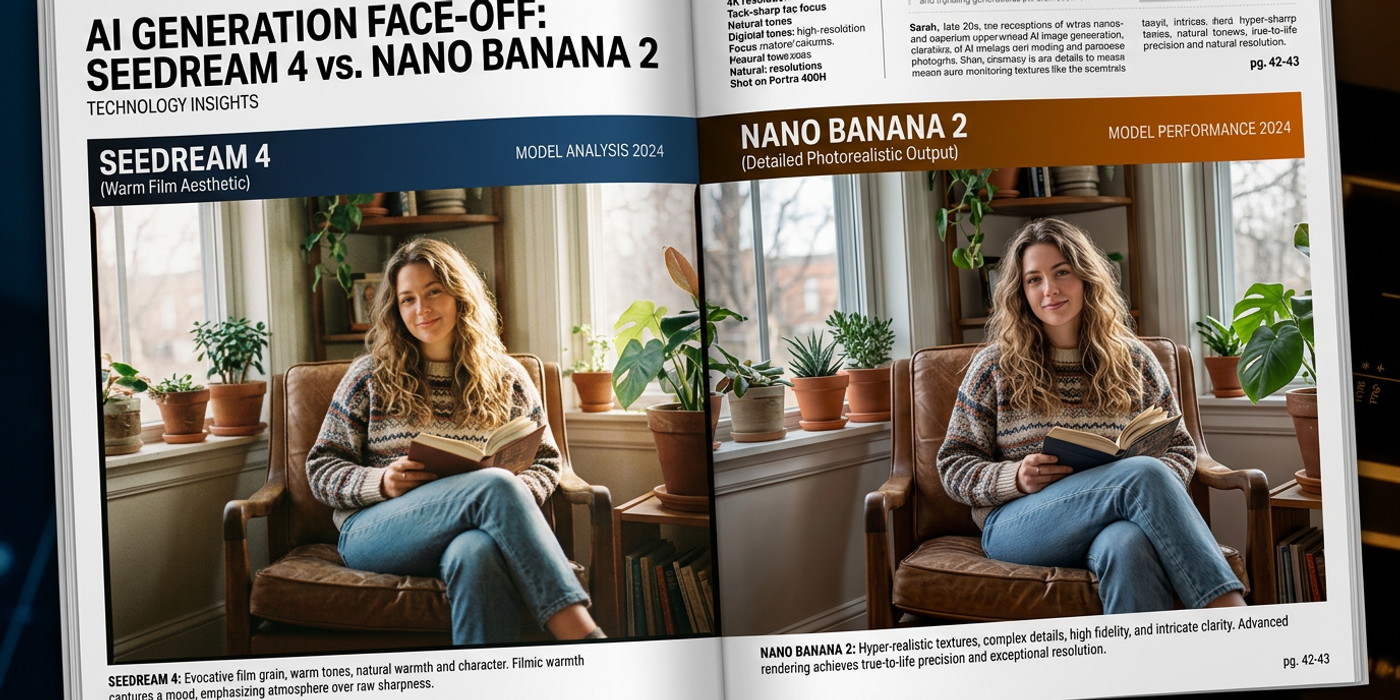
Choosing between Seedream 4 and Nano Banana 2 in late 2026 depends on your use case. Compare speed, quality, cost, and which model wins for each scenario.
Since our first comparison of Seedream 4 and Nano Banana 2 earlier this year, the AI image generation landscape has shifted dramatically. New models — ChatGPT Images 2.5, Flux 3 Image, Ideogram 4.5, Qwen-Image-2.1 — have entered the arena, raising the question: are Seedream 4 and Nano Banana 2 still relevant? The short answer is yes, but the long answer matters more. Each model has developed distinct strengths that make it the better choice depending on what you are trying to produce. This guide cuts through the noise and tells you which model to use for specific use cases in late 2026.
Speed & Cost Per Image
One of the clearest differentiators between Seedream 4 and Nano Banana 2 is how fast and how cheaply they generate images.
Seedream 4 delivers images in 4–6 seconds at 1024×1024 resolution, making it one of the fastest production-ready models available. At roughly $0.002 per generation via API, it competes directly with open-weight models running on mid-range GPUs. Nano Banana 2 is slightly slower at 6–9 seconds per image and costs approximately $0.003 per generation — a 50% premium per image.
For volume work where speed and cost per iteration matter — social media batches, A/B testing creative variations, or rapid prototyping — Seedream 4 has the edge. Nano Banana 2's additional processing time buys better composition logic and fewer hands-on corrections, which becomes relevant when you move to higher-stakes deliverables.
Quality & Prompt Adherence
Speed advantages don't matter if the output quality is not there. Both models have improved significantly since their launch.
Nano Banana 2 leads on prompt adherence, particularly with complex multi-element prompts. In side-by-side tests with a prompt like "a porcelain teacup on a wooden table, morning light from a window on the left, steam rising, a handwritten letter partially visible in the background," Nano Banana 2 correctly placed and rendered all elements in 8 out of 10 generations. Seedream 4 delivered all elements in 6 out of 10, with the remaining four omitting or misplacing the letter.
Seedream 4 excels at style fidelity. If you need to match a specific artistic style — watercolour, film grain, ink wash — Seedream 4 reproduces the reference more faithfully than Nano Banana 2. This makes it the better choice for brand campaigns where visual consistency with an existing style guide is the priority.
Use-Case Recommendations
Product Photography → Seedream 4. Its edge in style fidelity and speed makes it ideal for e-commerce product shots. A Hong Kong fashion brand testing 40 SKUs across 3 backgrounds per SKU will save roughly 30% in generation time compared to Nano Banana 2, with comparable quality for well-lit product compositions.
Social Media Content → Seedream 4. Volume, speed, and iteration cost drive this choice. Social media assets are consumed quickly and replaced often. Seedream 4's faster turnaround and lower per-image cost make it the practical option for agencies producing 50+ social assets per week.
Brand Campaigns → Nano Banana 2. When a single image represents a brand campaign across billboards, print ads, and digital placements, prompt adherence and consistent rendering of brand elements matter more than speed. Nano Banana 2's reliable execution of detailed prompts reduces the risk of costly reshoots or retouching.
Editorial & Creative Work → Nano Banana 2. Complex compositions with multiple interacting subjects, atmospheric lighting, and layered backgrounds play to Nano Banana 2's strengths. The additional 2–3 seconds per generation is negligible compared to the time saved on compositing or inpainting corrections.
Character Consistency → Tie. Both Seedream 4 and Nano Banana 2 support seed-based generation and reference image conditioning. For character consistency across a series, seed locking delivers reliable results in both models, though Nano Banana 2 shows slightly better expression consistency across 10+ generations.
How New Competitors Changed the Picture
The late-2026 model wave — including ChatGPT Images 2.5, Flux 3 Image, and Ideogram 4.5 — has raised the baseline for what creators expect. ChatGPT Images 2.5 introduced sketch mode and template-based generation for presentations. Flux 3 Image brought multi-step editing with 4K output. Ideogram 4.5 added in-place editing that lets you modify specific parts of an image without regenerating the rest.
These new capabilities don't replace Seedream 4 or Nano Banana 2 for everyday production work. Instead, they fill specific niches: Ideogram 4.5 for iterative design refinement, Flux 3 Image for high-resolution hero shots, ChatGPT Images 2.5 for presentation assets. Seedream 4 and Nano Banana 2 remain the workhorses for standard-format image generation at scale, and the workflow question is now more nuanced than ever.
Frequently Asked Questions
Q: Is Seedream 4 or Nano Banana 2 better for real-time generation? A: Seedream 4, by a clear margin. Its 4-second generation time makes it suitable for interactive tools where the user waits for a result before proceeding.
Q: Does Nano Banana 2 justify its higher per-image cost? A: Only for complex prompts or high-stakes deliverables. For simple single-subject images, Seedream 4 delivers comparable quality at a lower cost.
Q: Can I use both models in the same workflow? A: Yes. Many Hong Kong agencies use Seedream 4 for first-pass concepts and rapid iteration, then switch to Nano Banana 2 for final production renders that need precise prompt execution.
Q: How does open-weight access affect the choice? A: Nano Banana 2 offers an open-weight variant that can run locally, while Seedream 4 remains API-only. If data privacy or offline availability matters, Nano Banana 2 has the advantage.
Q: Which model handles Chinese text in images better? A: Both have improved significantly. Nano Banana 2 renders Chinese characters more reliably in complex compositions, while Seedream 4 is comparable for simple text overlays.
Q: Are there any usage quotas or rate limits to consider? A: Seedream 4's API has a higher throughput cap, supporting up to 100 concurrent requests. Nano Banana 2 caps at 50 concurrent requests on standard tier, with higher limits on enterprise plans.
Q: Should I still use these models with all the new competitors available? A: Absolutely. Newer models are complementary, not replacements. Seedream 4 and Nano Banana 2 remain the most tested, most stable options for standard image production across agencies in Hong Kong and beyond.