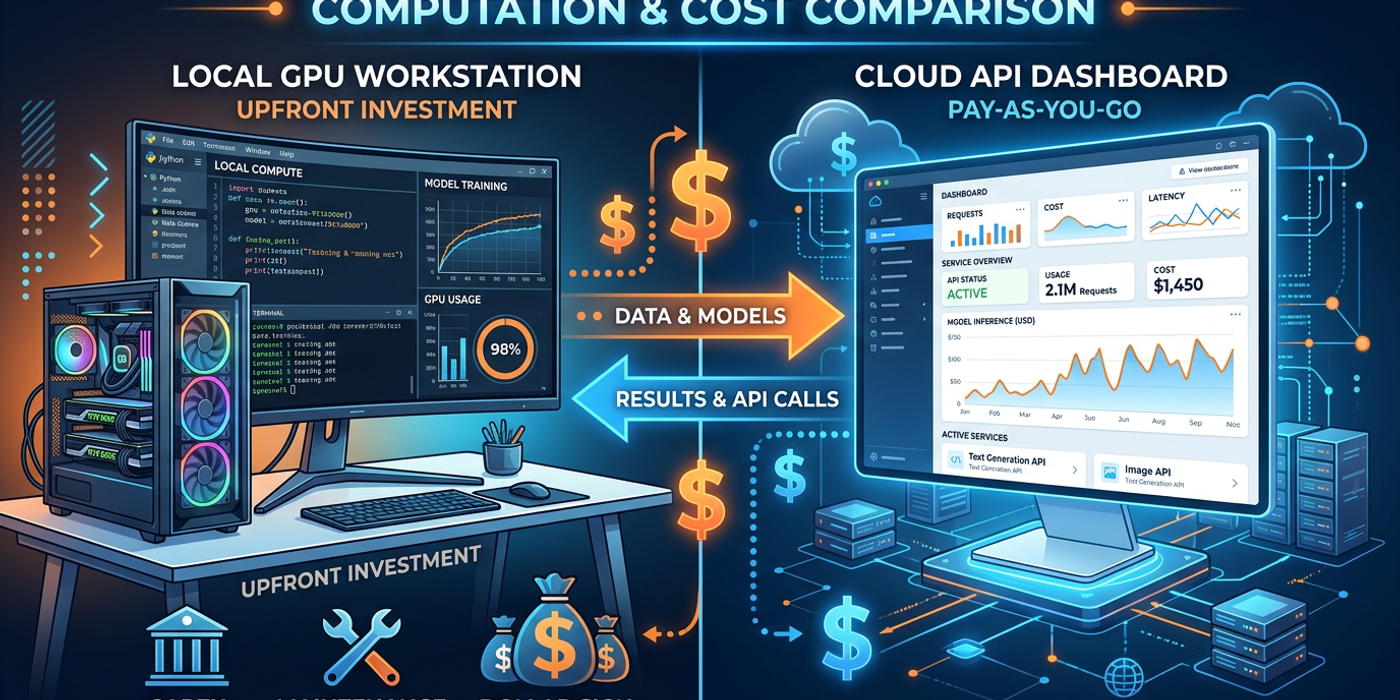
Open-weight AI models are reshaping creator budgets. Compare self-hosting vs API pricing to find the right cost mix for your workflow in late 2026.
The second half of 2026 has reshaped the economics of AI generation. Open-weight image models like Qwen-Image-2.1 and FLUX Schnell now run comfortably on consumer GPUs, while video models like LTX-2.5 bring 4K generation to local hardware. For Hong Kong creators and agencies producing consistent volumes, the question is no longer just which model to use — it is whether to pay per generation or run your own stack.
The gap between self-hosting and API costs has narrowed to the point where a hybrid strategy often beats going all-in on either approach. Understanding where each model sits on the cost-quality-speed triangle is the key to building a budget that works for your actual production volume.
The Open-Weight Wave That Changed the Cost Equation
The single biggest shift in AI generation costs since mid-2026 has been the arrival of production-ready open-weight models. Qwen-Image-2.1, released in September 2026, delivers image generation quality that rivals closed-source models at a price point of zero — if you have the hardware to run it.
LTX-2.5 brought 4K HDR video generation to open weights, and FLUX Schnell has become the default budget option for high-volume image work. These models change the math for anyone generating more than a few hundred outputs per month.
The key metric is cost per generation. A single FLUX Schnell image via API costs roughly 1 credit. Self-hosted on a consumer GPU, the same image costs a fraction of a cent in electricity. At 1,000 images per month, the savings of self-hosting can offset a mid-range GPU within three to four months.
When Self-Hosting Makes Financial Sense
Self-hosting is not for everyone, but it is increasingly viable for specific production profiles. The best candidates are creators and agencies who generate consistent volumes of image or short-form video content, have some technical capability to set up and maintain local inference, and produce work where latency is not the primary constraint.
A Hong Kong agency producing 2,000 social media images per month for client campaigns would pay roughly HKD 400—600 per month in API credits for FLUX Schnell or similar models. A used RTX 4090 at current prices costs around HKD 1,400—1,800 per month amortised over 12—18 months. The break-even point is roughly three to four months of consistent volume.
Beyond raw cost, self-hosting offers privacy advantages. Client briefs and brand assets never leave your network. There is no prompt logging, no API traffic, and no concern about model providers changing pricing or deprecating a version you rely on.
When API Services Are the Better Choice
API services still dominate for several common scenarios. Creators producing fewer than 300 generations per month will struggle to justify the upfront hardware cost of self-hosting. For experimental work — testing new styles, comparing models, or one-off client projects — APIs offer zero setup time and access to the latest frontier models.
Premium quality remains an API advantage. Models like Ideogram 4.5, OpenAI's ChatGPT Images 2.5, and Veo 3.1 continue to set the quality benchmark that open-weight alternatives have not yet matched. When a project demands the absolute best output, paying per generation for a top-tier model is usually the right call.
APIs also simplify collaboration. Teams that share credits, track usage across departments, or need to audit generation history benefit from the built-in dashboards and billing that API platforms provide.
Building a Hybrid Cost Strategy
The most cost-effective approach for most Hong Kong creators is a hybrid that uses each pricing model where it works best. Start by categorising your monthly output into three tiers.
Tier one is high-volume, quality-tolerant work: social media variants, A/B test assets, draft concepts, and internal mockups. Route these to self-hosted open-weight models. A single local instance of FLUX Schnell or Qwen-Image-2.1 can handle hundreds of daily generations at near-zero marginal cost.
Tier two is medium-volume, quality-sensitive work: client-facing presentations, paid ad creatives, and e-commerce product images. Use API services but choose budget-friendly models. FLUX Schnell via API, Stable Diffusion 3.5 Turbo, or Gemini Omni Flash for video drafts keep per-unit costs low while maintaining reliable quality.
Tier three is low-volume, premium work: hero images, brand campaigns, video final renders, and projects where the model choice directly impacts the creative outcome. Pay full API rates for frontier models like Ideogram 4.5 for image or Veo 3.1 for video. These are your highest-value outputs where a 10—20 percent quality improvement justifies the per-generation cost.
The Hidden Costs of Each Approach
Self-hosting has costs beyond the GPU. Electricity, cooling, internet bandwidth, and your time for setup and maintenance all add up. A 400W GPU running eight hours per day at Hong Kong electricity rates adds roughly HKD 150—200 per month to your bill. Software updates, model downloads, and compatibility fixes consume a few hours per month.
API costs are more predictable but carry their own hidden factors. Prompt engineering waste — running a generation that does not land and needs a second or third attempt — effectively doubles or triples your per-success cost. Model provider lock-in means that switching to a cheaper alternative later may require workflow changes or prompt rewrites.
For most creators, the real cost optimisation comes not from choosing one approach over the other, but from designing a workflow that routes each task to the most cost-appropriate model automatically.
Frequently Asked Questions
Q: What is the cheapest way to start with self-hosted AI generation? A: A used RTX 3060 with 12 GB VRAM can run FLUX Schnell and Qwen-Image-2.1 at acceptable speeds. Total cost including a second-hand PC is roughly HKD 5,000—7,000.
Q: How much can a Hong Kong agency save by self-hosting? A: Agencies producing 1,500—2,000 images per month typically save 50—60 percent on generation costs after the initial hardware investment is amortised.
Q: Is self-hosting suitable for video generation? A: For short clips under five seconds, yes — LTX-2.5 runs on a single 24 GB GPU. Longer or higher-resolution video still benefits from API services due to VRAM limits.
Q: Does self-hosting void model licensing terms? A: Open-weight models like Qwen-Image-2.1 and FLUX Schnell permit local deployment under permissive licenses. Always check the specific model's license before commercial use.
Q: Which models give the best API value for money? A: FLUX Schnell and Stable Diffusion 3.5 Turbo offer the best cost-per-quality ratio for images. Gemini Omni 1.1 Flash is the most cost-effective option for video drafts.
Q: Can I run multiple models on one GPU? A: Yes, but only one model loads into VRAM at a time unless you use model offloading, which slows generation significantly. A single GPU is best for one primary model.
Q: How do free tiers fit into a cost strategy? A: Free tiers from ElevenLabs Music and similar services are excellent for exploration and low-stakes work, but they lack the consistency and reliability needed for client production.
Q: What is the biggest cost mistake creators make in 2026? A: Using a single premium model for all work instead of matching model tiers to task value. The most expensive generation is the one where you use the wrong model for the job.