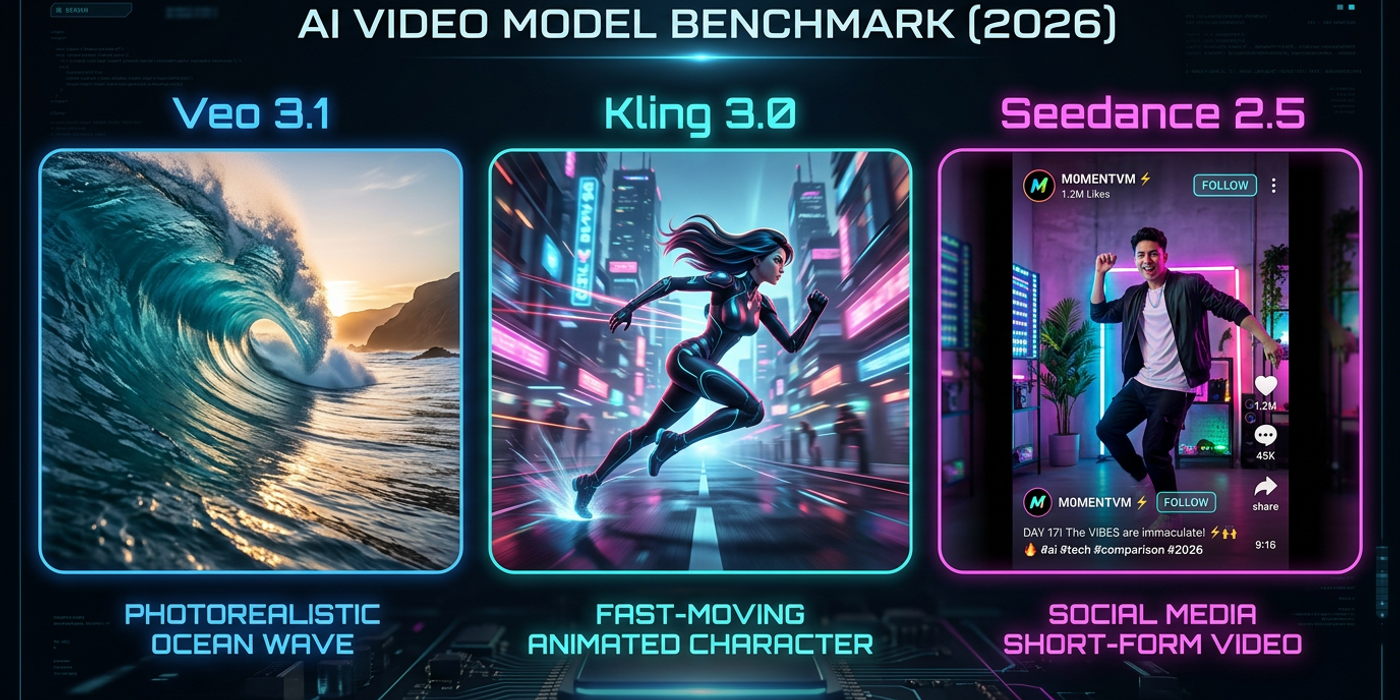
Veo 3.1, Kling 3.0, and Seedance 2.5 face off in 2026. Compare quality, speed, resolution, and pricing to find the best AI video model for your projects.
AI video generation has evolved fast in 2026, and three models dominate the conversation: Google's Veo 3.1, Kuaishou's Kling 3.0, and ByteDance's Seedance 2.5. Each offers distinct strengths, and choosing the wrong one costs you time, quality, or both.
If you need photorealistic output with the best physics simulation, Veo 3.1 leads. If speed and iteration matter most, Kling 3.0 finishes renders in half the time. And if you're producing short-form social content with tight brand consistency, Seedance 2.5 delivers impressive 30-second clips natively.
Here's how they stack up in mid-2026.
What Veo 3.1 Does Best
Veo 3.1 remains Google's flagship video generation model, and it excels where it always has: realism. The model simulates physics more accurately than its competitors — water flows naturally, fabric drapes correctly, and reflections behave as expected. For Hong Kong agencies producing luxury brand content or product showcases, this matters.
Key specs: 1080p resolution, up to 60-second clips, SynthID watermarking, text-to-video and image-to-video modes. Veo 3.1 integrates directly with Google Cloud's Vertex AI, making it accessible for teams already in the Google ecosystem.
The biggest improvement in 2026 has been scene consistency. Earlier Veo versions sometimes shifted character appearances between shots. Version 3.1 largely solves this, maintaining consistent faces and clothing across multi-shot sequences — critical for narrative-driven brand content.
Where it falls short: Render speed. A 30-second 1080p clip takes 8-12 minutes on average. That's fine for final delivery but too slow for rapid iteration during creative development.
Kling 3.0: Speed Champion
Kuaishou's Kling 3.0 has carved out a clear niche: speed without sacrificing quality. Where Veo 3.1 takes 10 minutes for a 30-second clip, Kling 3.0 delivers similar-quality output in 3-5 minutes.
What's new in 3.0: Native 1080p output (previous versions required upscaling), improved motion coherence — characters and objects move more naturally across frames — and a new End of Video feature that generates a clip's final frames from a description, making loopable content much easier to produce.
Kling 3.0 also offers the best text rendering of the three. If your video needs on-screen Chinese or English text (common for Hong Kong social ads and title cards), Kling handles it more reliably than Veo or Seedance.
Where it falls short: Physics simulation isn't as refined as Veo 3.1. Complex interactions — pouring liquid, cloth folding, hair movement — can look slightly off. For product demos with intricate physical detail, Veo is still the safer bet.
Seedance 2.5: The Social-First Option
ByteDance's Seedance 2.5 launched in July 2026 with a clear target: short-form social content. While Veo and Kling generate clips up to 60 seconds, Seedance 2.5 produces 30-second clips natively but at higher consistency.
The killer feature: 30-second single-shot generation without stitching. Most AI video models cap individual clips at 5-10 seconds, requiring you to stitch segments together. Seedance 2.5 outputs full 30-second clips in one pass, maintaining consistent style, lighting, and character appearance throughout. For TikTok, Instagram Reels, and YouTube Shorts, this is a massive workflow advantage.
Seedance 2.5 also integrates tightly with CapCut and Douyin's ecosystem — if your post-production workflow already uses ByteDance tools, the pipeline is seamless.
Where it falls short: Resolution tops out at 720p native. You'll need upscaling for 1080p delivery. Prompt adherence is good but not as precise as Veo 3.1 — abstract or highly specific visual instructions sometimes get interpreted loosely.
Side-by-Side Comparison
| Feature | Veo 3.1 | Kling 3.0 | Seedance 2.5 | |---------|---------|-----------|-------------| | Max Resolution | 1080p | 1080p | 720p (upscalable) | | Max Duration | 60s | 60s | 30s | | Render Speed (30s clip) | 8-12 min | 3-5 min | 4-6 min | | Physics Simulation | Excellent | Good | Good | | Text Rendering | Good | Excellent | Fair | | Scene Consistency | Very Good | Good | Excellent | | Pricing | ~$0.15/s | ~$0.08/s | ~$0.06/s | | Best For | Premium brand content | Fast iteration & ads | Short-form social media |
Which Model Should You Choose?
For luxury brand videos and cinematic product showcases, Veo 3.1 is the clear choice. The physics accuracy and scene consistency justify the longer render times and higher cost.
For social media ads running on Meta, Google, or programmatic display, Kling 3.0 offers the best speed-to-quality ratio. Being able to iterate through 3-4 variations in the time Veo produces one is a real advantage in campaign development.
For TikTok, Reels, and Shorts-first content, Seedance 2.5's 30-second single-shot generation is unmatched. If your entire distribution is short-form vertical video, the lower resolution is acceptable and the workflow efficiency is hard to beat.
Many Hong Kong agencies are now using a hybrid approach: Veo 3.1 for hero content, Kling 3.0 for A/B test variations, and Seedance 2.5 for daily social output. That composable strategy maximizes each model's strengths while keeping costs manageable.
Frequently Asked Questions
Q: Is Veo 3.1 worth the higher price for short-form content? A: Not usually. For 15-30 second social clips, Kling 3.0 or Seedance 2.5 deliver comparable quality at half the cost and faster speeds. Reserve Veo for premium, longer-form projects.
Q: Can Seedance 2.5 output be used for broadcast-quality video? A: Not directly. Native 720p resolution requires upscaling for broadcast or large-format display. For digital social channels, the native output is sufficient.
Q: Which model has the best Chinese-language text rendering? A: Kling 3.0 leads for on-screen text in both Chinese and English. Seedance 2.5 handles Chinese text reasonably well, while Veo 3.1's text rendering is its weakest area.
Q: How do render times compare for image-to-video workflows? A: The spread narrows with image-to-video because the model has a starting frame. Kling 3.0 still leads at 2-4 minutes for a 30-second output, with Seedance 2.5 at 3-5 minutes and Veo 3.1 at 6-9 minutes.
Q: Can these models generate consistent characters across multiple clips? A: Yes. All three support reference-image workflows for character consistency. Seedance 2.5 has the strongest character lock within a single 30-second clip, while Veo 3.1 is better at maintaining consistency across separate clips for longer narratives.
Q: Do any of these models support native audio generation? A: Not yet. All three output silent video. You'll need a separate tool (like ElevenLabs or MiniMax H3) for audio and sound effects. This is an active area of development — expect native audio in the next major versions.
Q: Which model is best for Hong Kong real estate video walkthroughs? A: Veo 3.1's physics simulation produces the most realistic architectural renders. For property walkthroughs where spatial accuracy matters, it's the strongest choice despite the slower render times.
Q: Are there free tiers for any of these models? A: Kling 3.0 offers a limited free tier (5-10 generations per day). Veo 3.1 is available through Google Cloud credits but has no permanent free tier. Seedance 2.5 requires a ByteDance account and offers trial credits for new users.